

There is a tradition of thinking that goes all the way back to the ancient world that is centered on dealing with tensions, oppositions, and contradictions. Civic Fields is very much centered in this tradition. There are, to be sure, things in the world that need categorical rejection, an Absolute No, or categorical acceptance, an Absolute Yes, but they are few and far between. Most things need a Yes and a No, and today, “AI” is one of those things. Civic Fields is, in general, on the skeptical and critical side of the AI debate, but not because of the technologies themselves, but because of what they are being martialed to do and, crucially, by whom they are being martialed. AI need not be so deleterious to our civic and economic life. It could be used for better purposes. Valentina Fazio is a data researcher in Amsterdam, and among the folks I’ve read is one of the very best in thinking about how to say Yes to AI for civic goods. - Ned
In her kept journal, Anna Dostoevskaya, wife of Fyodor Dostoevsky, chronicled her and her husband’s time in Switzerland—a two-year period of extreme poverty and health complications. After visiting the Kunstmuseum in Basel, she describes the effect a great painting had on her husband: Hans Holbein the Younger’s The Body of the Dead Christ in the Tomb (1520-1522).
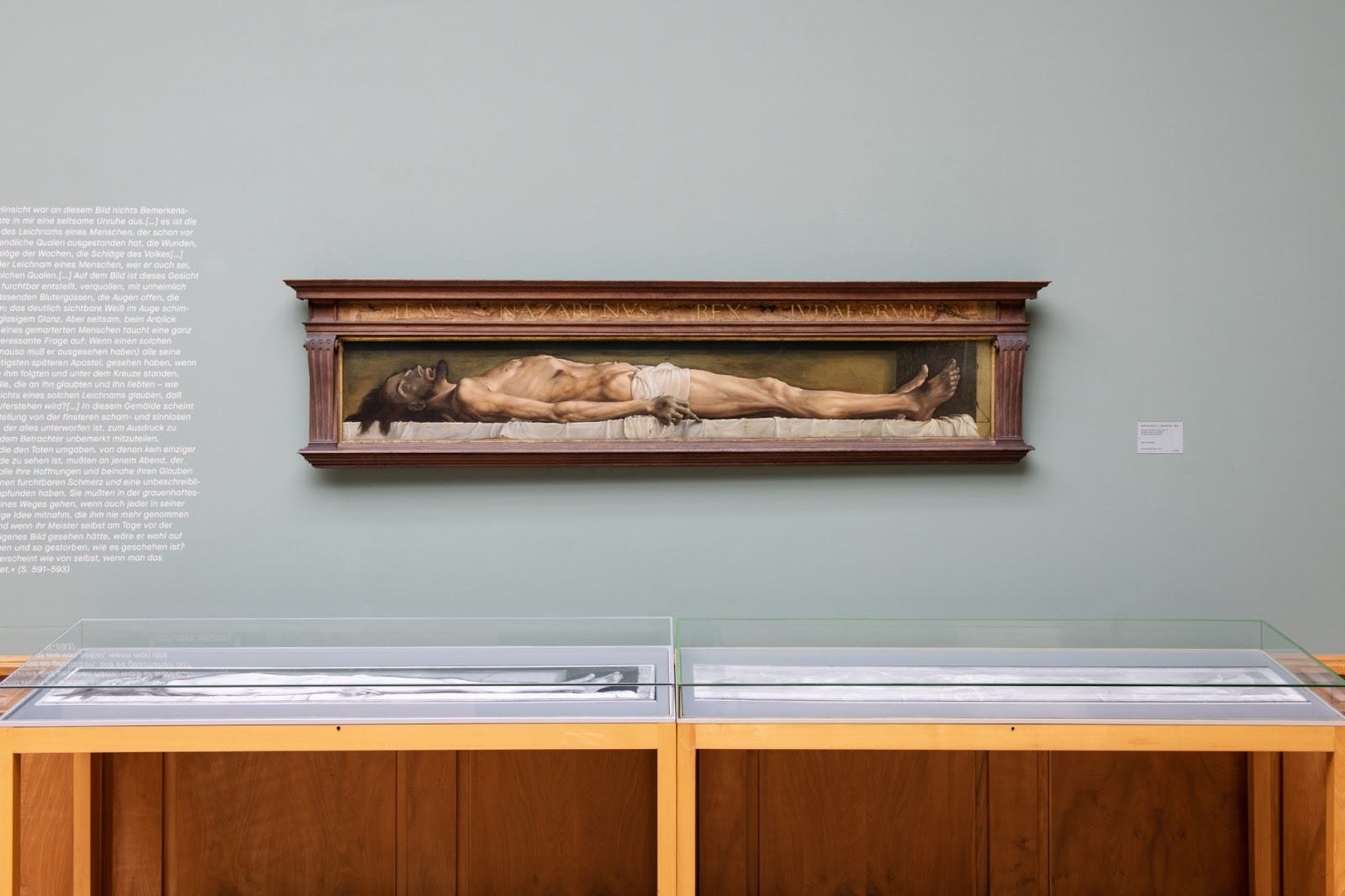
The tortured, decaying body of Christ depicted on the six-foot-long, one-foot tall canvas inspired such despair and shock in Fyodor Dostoevsky that he suffered an epileptic seizure in the gallery. It was the experience of Holbein’s Christ that inspired the great novelist to write a story from the perspective of a Christ-like man, resulting in Prince Myshkin in The Idiot.
The relationship between lived experience, the painting, and the novel, reconstructs a greater historical context, one that reminds us that art comes from people who have suffered losses, overcome obstacles, and lived in our same world.
While information about Dostoevsky’s experience exists—in Anna’s journals, in biographies, in curatorial studies—it rarely appears in the metadata (or, “data about data”) of the painting itself, whether in a museum’s digital archive or online database. What we encounter instead is a disconnected series of digital silos: one record for the artwork, another for the author, another for the seizure anecdote.
The connective tissue—the human narrative—is missing.
This absence reveals something deeper about our civic relationship to culture in the digital age.
Information is abundant, but meaning is not.
The original promise of the internet was a democratic one: a digital landscape where people and information could be connected across the globe, where knowledge was no longer gated by geography or privilege. Museums, libraries, and archives embraced this mission with enthusiasm. In the last thirty years, the world’s cultural memory—artworks, manuscripts, photographs, films—has been digitized and placed online, accessible to most anyone with a Wi-Fi signal. Such a powerful influx of cultural data makes the question of comprehensiveness rear its head, as access alone does not connect the public to digital reproductions of culture and art.
When we open a museum’s online collection, we might find Holbein’s Dead Christ. We see a high-resolution image, the artist’s name, the year, and a short curatorial text. But we won’t find the network of relationships that gives it life: Dostoevsky’s seizure, Anna’s journal, the broader 19th-century conversation of faith and despair. That kind of relational knowledge—the story behind the data—remains unstructured, dispersed, or buried in other databases.
Digitization achieved access. It did not achieve a connection. And in civic terms, that distinction matters.
In a healthy civic society, knowledge functions as a public good: it connects citizens to history, to each other, and to the moral and emotional lessons embedded in art and literature. But when our collective knowledge is scattered across opaque platforms, accessible only through precise keywords and institutional boundaries, our civic relationship to culture becomes transactional rather than participatory.
Every search online begins with two questions:
Where am I going to search for this?
What am I going to search for?
These questions are deceptively simple. To ask them well, one must already know something about how information is stored, who owns it, and what kind of language will retrieve it. Searching effectively online, whether for a historical detail or an obscure artwork, requires not just curiosity but fluency in the architectures of the digital world. Keyword-based search flattens meaning. It retrieves results based on literal matches, not conceptual ones. A query for “Dostoevsky Holbein Christ” may produce relevant results—but it won’t connect you to, say, other writers moved by depictions of suffering, or artists who explored the same theological questions. The search engine doesn’t understand why you’re asking—it only matches what you type.
This is the civic cost of digital fragmentation: knowledge becomes a puzzle that only the digitally literate can solve. Those without the right words—or the right search platform—are excluded from discovering the deeper relations that make culture meaningful.
Artificial intelligence, as most people encounter it today, is “generative”—it produces new text, images, or sounds.
But there is another dimension of AI that holds more civic promise: semantic AI.
Semantic AI doesn’t generate new content; it interprets relationships. It connects meaning, context, and association across diverse data sources.
In practical terms, this means that instead of simply “finding” files, it can connect knowledge. It can link Holbein’s Dead Christ to Dostoevsky’s seizure, Anna’s journals, the Basel museum records, and broader discussions about suffering and faith in European literature.
Information can be stored in knowledge graphs or relational databases—networks of interconnected information that reflect how human understanding actually works—and searched semantically, traversing through entities and their related or overlapping connections.
In a semantic web of culture, The Dead Christ is no longer just a painting. It’s a node in a living constellation that includes literature, religion, philosophy, and history.
Imagine searching for “artistic depictions of Christ-like figures” or “19th century ideas about religion” and being guided through a semantic map of interrelated sources: Holbein’s Christ, Dostoevsky’s The Idiot, Nietzsche’s The Antichrist, and contemporary works exploring resurrection or decay.
That is not keyword retrieval—it is conceptual navigation. In civic terms, it represents a shift from passive access to active participation in cultural understanding for the public.
If storage and search define the backbone of cultural digitization, semantic AI reimagines both. Traditional databases are built around fixed categories: artist, title, date, medium. They work well for inventory, but poorly for interpretation.
Human knowledge, by contrast, is associative, fluid, and contextual.
Emerging models like Linked Art and Europeana’s data framework are early examples of how institutions can use semantic structures to connect their archives. With semantic AI layered on top, such systems could become truly civic infrastructures—commons of cultural knowledge navigable by meaning rather than code.
This is not just about museums or academia. Think of public broadcasters, local archives, or libraries that hold oral histories, ephemera, or community art projects. Right now, these materials live on isolated platforms, discoverable only if you already know they exist. Semantic AI could give them visibility in the broader web of cultural history, allowing a school student in Amsterdam or Nairobi to follow a thread from Dostoevsky to Holbein to their own community mural.
The architecture of storage thus becomes an architecture of civic memory.
We often talk about AI as a threat to human creativity or as a tool for efficiency. But AI’s most meaningful civic potential lies in its capacity to reconnect. By mapping relationships between dispersed data, AI can rebuild a sense of continuity that the internet’s platformization fractured.
In a time when civic discourse is fragmented—when every domain of knowledge has its own algorithmic echo chamber—the idea of shared cultural understanding feels increasingly fragile. Semantic AI offers a counterpoint: a way to see the connections that link different forms of human expression, and to experience culture as a living system rather than a series of isolated posts, records, or thumbnails.
As Frederic Jameson puts it:
The history of an artwork and its materiality are inextricable, and recognition of this dichotomy can only come to be through knowledge, a knowledge which is not distinct from the aesthetic that henceforth includes it.
Understanding art requires understanding its history—and therefore, the social and political conditions that shaped it.
To make that kind of understanding available to everyone—to embed it in our digital infrastructure—is a civic act.
The internet began as a public project, a network meant to democratize knowledge. But as platforms privatized discovery and fragmented attention, the web lost its connective ethos.
To rebuild a civic internet, we must rebuild civic meaning.
Semantic AI offers not just a technical solution, but a philosophical one. It encourages us to see data not as property, but as shared understanding; not as isolated facts, but as relationships. It has the potential to make our digital culture participatory again—to turn archives into conversations and collections into communities of knowledge.
Of course, no technology is neutral or without flaws. Semantic AI will inherit biases from the data it learns on, and its interpretations will always reflect the limitations of human description. But unlike the generative tools that flood our feeds with synthetic “content,” semantic applications aim to clarify rather than obscure—to deepen our understanding rather than imitate it. In this way, they counteract the cultural noise produced by generative excess. When used for the public good, these systems can restore a kind of epistemic balance, helping us make sense of what already exists instead of drowning in endless reproductions of it.
When Dostoevsky stood before Holbein’s Dead Christ, what he saw was not just the body of Christ, but a mirror of human despair and endurance. That moment—its fragility, its depth—exists in our collective memory, but only if we can find it, connect it, and make it visible. In an age of overwhelming information, the task before us is not to digitize more, but to reconnect what we already have—to rediscover the human meanings that lie dormant in our digital archives, and in doing so, to rebuild the civic web.
Valentina Fazio holds a Master’s degree in Cultural Data and AI from the University of Amsterdam, and researches how flexible data storage structures and artificial intelligence can aid in the recontextualization of artwork within broader cultural and historical frameworks.
