

As we sit day to day and watch the president and the woefully unqualified “Secretary of War” flail amid strategic failure in their self-chosen war against Iran, the cartoon-like character of our most powerful public officials only grows thinner and thinner and grimmer and grimmer. If they weren’t all so horribly deadly and disastrous, they would simply be embarrassing. And that would be enough. In a series of clickbait acts of arrogance, they’ve made what was a Middle-East crisis a global one, and a strategic struggle with an isolated state a potential world war. A national embarrassment.
Speaking of embarrassing, have you heard about the Adams County, Ohio sheriffs? Perhaps you’ve come across Afroman as of late?
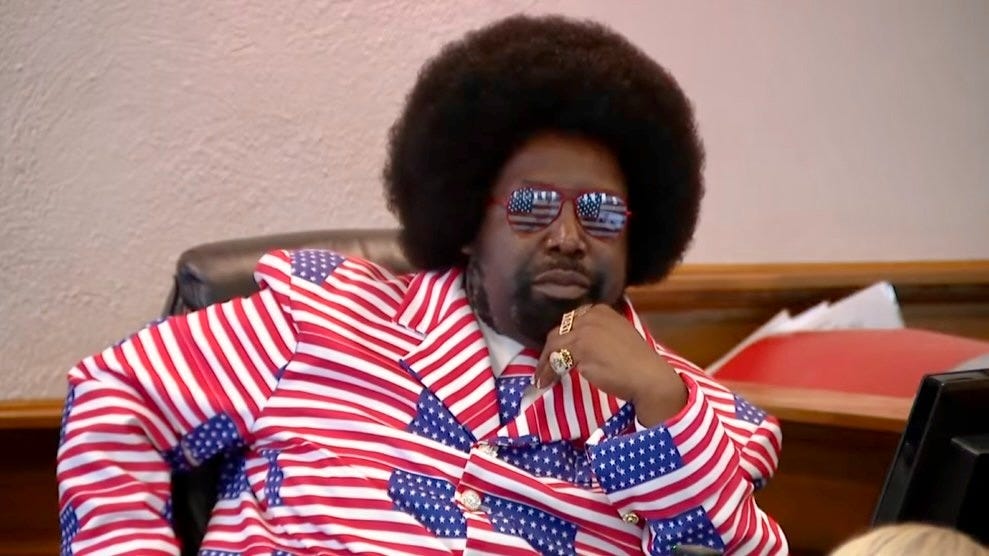
If you have not gotten in yet on the travails and trials of Afroman and the Adams County Sheriff’s Department, Civic Fields is glad to introduce you. I think he teaches us something about the art of public shaming.
Afroman is a rapper. I missed his only big hit, the humor-filled “Because I Got High,” which came out in 2000 (admittedly, for me, not much to miss). Since then, the artist has been releasing music on the internet and doing small gigs here and there.
Back in August of 2022, a team of careless sheriff’s deputies from Adams County, Ohio, broke down the door and raided the home of Joseph Edgar Foreman, a.k.a. Afroman. Yes, they had a search warrant in hand—but it was based only on the scantiest of evidence for their SWAT-style operation. A single informant, apparently Foreman’s ex, told them that Foreman was trafficking large amounts of weed, kidnapping women, and using his basement—described by the informant as a “dungeon”—to imprison his victims. These are serious accusations, to say the least, so wild that they might cause a deputy to want to check their veracity before getting too worked up. The Adams County sheriff’s department, however, bypassed this step and took the informant at her word.
Foreman is a black man, and Adams County, Ohio, is 96% white—as is, it seems, the sheriff’s office. Even “worse,” Foreman is a rapper who sings about weed and performs under the name Afroman.
Foreman was out of town when the sheriffs arrived and busted through his driveway gate and front door. But his children were at home, being cared for by his ex-wife. As they looked on with horror, the sheriffs, guns drawn, proceeded to scour the house like they were entering a drug lord’s enclave. Their search was futile. They dug through Foreman’s closet, rummaged through his CD collection, and looked behind couches and under tables with bewilderment.
When they discovered that they were being watched by the cameras of a home security system, they proceeded to disconnect it, but not before one deputy flipped the bird at a camera.
Needless to say, the sheriffs did not find any kidnapped women. They did not even find a basement or “dungeon”—for there was none, just a slab (a basic fact they surely could have investigated before battering their way into Foreman’s house). And they discovered only the tiniest amount of weed. No charges were filed. Nevertheless, they took into custody “evidence” in the form of $5000 in cash. Eventually, Foreman got $4600 of it back.
By any reasonable standard of “probable cause,” the operation was unwarranted. It was terrifying for Afroman’s kids. And it was humiliating for Foreman, who as a black man represents less than a half-percent of the Adams County, Ohio population.
What about the sheriffs? It is tempting to label them cruel and unjust, but mostly they were just incompetent and thoughtless.
Which raises the question, how should we respond to the bad behavior of public officials?
Shaming is one legitimate way.
But shame needs care—better, it needs art. For shame is a double-edged sword. So much of “cancel culture” is a form of shaming, and so much of cancel culture is wrong and unjust. It has done great personal and public harm to its targets while doing little that is productive for democracy.
Cancel culture represents a form of shaming meant to banish people from public life. It is a form of mob punishment. It is fundamentally paternalistic: we know what is righteous; you are unrighteous; be gone! It is no different in structure than the worst forms of mob violence against people accused of social transgressions, e.g. lynching (though it is very different in form).
Yet, democracies need the capacity to shame public actors who behave badly. Shaming can be used to call people to be better in public life. A great part of the devolution of public culture in the United States is fundamentally about how we’ve replaced the art of shaming with either (1) the blunt force of cancel culture, or (2) utter shamelessness.
Afroman, of all public people, teaches us something about a better way to approach shaming in a democracy.
Before his security cameras were disconnected, Afroman got ample footage of the actions of the sheriffs in their embattled excursion into his harmless house. His ex-wife also captured a video on her phone of the deputies at work. The year after his home was raided, Afroman used this footage to make a series of music videos about what happened to him.
The music videos have the form of plaintive satires. And they are hilarious.
One video, called “Will you Help Me Repair My Door?”, shows footage of the tactical-geared sheriffs busting down his door and searching his property with bewilderment. Another, called “Lemon Pound Cake,” pokes fun at a pot-bellied sheriff’s deputy caught on camera eyeing the pound cake on Afroman’s kitchen counter. A third, called “Why You Disconnecting My Video Camera?” is, well, self-explantory.
The music in these videos is cheesy (“Lemon Pound Cake” is sung to the tune of “Under the Boardwalk”). The lyrics are funny in an understated sort of way. The edits and graphics are willfully campy. That is, nothing about these videos suggests that they should be taken seriously . . . except the shameful, and at times stupid, behavior of the sheriffs that they portray.
Afroman was engaged in the art of public shaming.
I want to put a strong stress on “art” here, for so much of “cancel culture” is just artless and cruel, no better in its political or moral quality than a bunch of white deputies showing up at a black man’s house on the flimsiest of evidence and making a mess of things.
But Afroman does not “cancel” the sheriffs. He simply showed them to the world in all their incompetence, poking a humorous and biting finger at them (ok, sometimes a crude and humorous finger).
What can we learn about the art of public shaming from Afroman?
Several things stick out to me.
First, Afroman shames, but he is so far from self-righteous. To the contrary, he’s self-deprecating. The stories he tells in the music videos are about injustice and incompetence of the sheriffs rather than about his own self-righteousness or victimization. Indeed, he goes out of his way to portray himself in such a way that no one would ever mistake him for being a man without sin.
Second, Afroman messes with rather than complains about power differentials. For him, the profound power differential between white law enforcement and black life at once does and doesn’t matter. Part of his art of shaming entails drawing attention to his and his kids’ victimized position in the whole affair. Yet, Afroman does not act like a victim. Instead, he goes artfully on the offensive. As he later said, he sought to “turn my bad times into a good time,” and it is the manifest good time that he is having in his videos that helps make them so viral and so effective as satire. On social media, rage and anger may get momentary attention, but artful humor like this gets both attention and retention.
Third, the music videos leave viewers with ample room for interpretation. As some of the titles to the songs suggest, they question more than they condemn. This is a good approach to using shame in political rhetoric. Keep it loose. “Why You Disconnecting My Video Camera?”
Finally, Afroman addresses the sheriffs as equals. That is, he shames without paternalism. There is no effort to send the kids off to their rooms here, no stirring up an online mob to acts of banishment. Does Afroman “disrespect” the sheriffs? Yes and no—he gives them the level of respect their behavior warrants, no more or less. He treats them no differently than he would want to be treated himself: you get what you deserve. Or, put another way, be better than this! This is egalitarianism at work. (And it is sadly what too many in law enforcement in the United States have chosen to evade, hiding bad behavior behind the paternalistic power of the badge.)
This last feature of Afroman’s plaintive satires—shaming without paternalism—seems to me the most crucial thing we can learn from him about the art of shaming in democratic public life.
The story of Afroman and the sheriffs gets worse, or better, depending on how you look at it. The sheriffs, unlike Trump and his lackeys, apparently retained the capacity to feel shame. We should celebrate this. Good for them! But they chose to respond to their public shaming by digging themselves further in. They filed a civil lawsuit against Afroman for defamation of character, asking for nearly $4 million in damages.
Afroman was vindicated before a jury in court, but not before the sheriffs walked right into even more embarrassing moments while testifying on the stand.
And Afroman only wanted them to be better.