

Almost exactly 23 years ago, under President George W. Bush, the United States invaded Iraq in an onslaught called “Operation Iraqi Freedom.” When it comes to war, names may seem insignificant, but they are politically telling. They represent the book title, the headline, or the banner under which the battles are rationalized, a public statement that summarizes the casus belli, the cause for war, at least in the popular imagination. In tagging the war in Iraq “Operation Iraqi Freedom,” the Bush administration was saying to the public: This war is meant to liberate the people of Iraq. They have suffered under a brutal dictator for too long. We intend to free them and let them rule themselves.
Of course, this was not the only justification for the war in Iraq. On February 5, 2003, U.S. Secretary of State (and former army general) Colin Powell made a speech before the United Nations Security Council in which he argued that Iraq possessed dangerous weapons of mass destruction that could do grave damage to Europe and America unless destroyed. He claimed that these weapons meant Iraq was in direct violation of the U.N. Security Council Resolution 1441, and an armed invasion was justified.
Almost all of this, it turns out, was bunk. The great damage done by the Bush administration to public confidence is still playing out.
But at least they tried.
That modern presidents name wars or otherwise seek to justify them is itself worth noting—we have seen, historically, great efforts at trying. FDR, of course, did not name “World War II” and while the D-Day assault was tagged “Operation Overlord,” this was for purposes of operational security, not public relations. FDR would refer to the war in Europe rather blandly as “the present war” and speak of the fight against the Axis. But he had no big brand for the war. Because he did not need one. People understood what the war was about and why it mattered. Famously, FDR went before the American people after the attack on Pearl Harbor and presented the case for war.
Until our present war in Iran, presidents always made such live primetime speeches to try to explain the casus belli. Beginning in the 1980s, with the invasion of Grenada, they also started to name or brand these wars, perhaps unsure of the merits of the case.
Reagan, therefore, dubbed Grenada “Operation Urgent Fury.” George H. W. Bush called the invasion of Panama “Operation Just Cause.” He followed it with “Operation Desert Storm,” the U.S.’s first invasion of Iraq in 1991.
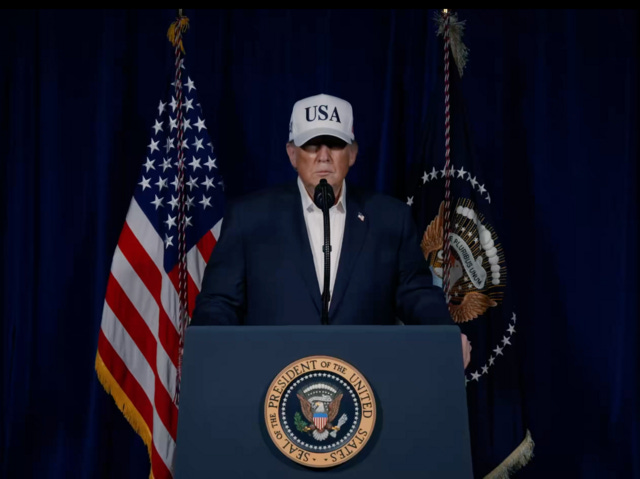
Which brings us to the Trump administration naming the war in Iran “Operation Epic Fury.” The name by itself is not particularly remarkable. It may (albeit I am skeptical) represent an homage to Reagan’s invasion of Grenada. I think it was more likely chosen because it sounds like a good name for a video game. (“Operation: Desert Storm” also became the name of a video game, which seems all the more relevant now in the age of Hegseth.) “Operation Epic Fury” rolls off the tongue like a 12 year old rolling into a skate-boarding park.
Its banality, however, is its most important political feature. Unlike “Operation Iraqi Freedom,” “Operation Epic Fury” is meaningless. It says only, “We’re pissed!”—and even then it is not clear who is pissed or why, let alone why now?
So, too, unlike the elaborate skeins of fact and fiction wound together by the Bush II administration to justify the second Iraq war, the Trump administration has made almost no effort to convince a doubtful American public of the need to go to war with Iran. The reasons the Trump people have offered do not stand up to even modest scrutiny:
Iran is the largest supporter of state-sponsored terrorism in the world. . . . Ok, so if the regime is toppled, who will be next? There will always be a “largest” supporter of state-sponsored terrorism until there is no more state-sponsored terrorism. Is that what we’re after? War on Terror 2.0? And why spend billions on state-sponsored terrorism when non-state sponsored terrorism can be just as deadly?
Iran someday (?), soon (?), will acquire a nuclear weapon and we can’t have nuclear weapons in the Middle East. . . . I thought we took care of Iran’s nukes several months ago, at least that’s what Trump said. And what of Israel’s arsenal of nukes?
We started this war because if we didn’t, Israel was going to do it, which would provoke Iran to attack U.S. bases in the Middle East, so therefore we needed to attack Iran first to prevent Iran from attacking U.S. bases, which Iran has since done anyway, and that’s why we did this. . . . Psychedelics anyone? Might help with lucidity.
The fact is that the Trump administration is clearly not trying. The question is, why are they not trying? And the answer to that question, I suggest, tells us why we went to war with Iran.
The Trump administration is not trying because they do not believe they need to try. And they’re right about this! Through a long history of choices and events that far precede the rise of Trump, the war-making powers of the executive have been largely removed from popular and Congressional governance. I know some of you may be growing weary of me saying this, but functionally speaking, we live under an elected monarchy, especially in foreign policy.
Again, there is a long history here, but it is one that can be traced back to the very founding of the United States itself.
Amid the debates and disputes around the crafting of the U.S. Constitution, the founders tried to find a sweet spot between too much hierarchy in government and not enough hierarchy. They all understood this sweet spot as the space of “republicanism.” Republicanism rejected monarchy—that is, too much hierarchy. Yet, at the same time, republicanism, at least as it was generally understood among the founders, rejected mere confederacy—that is, a flat system premised on state power with relatively little role for a federal government. The very idea of a federal union, or a formal federation of states with a central government, was an attempt to strike a balance between national centralization and total decentralization, or between a strong hierarchy and no hierarchy.
The men who won the day on this matter were deemed the “Federalists.” The Federalist Papers, the collective work of Alexander Hamilton, James Madison, and John Jay penned under the pen-name “Publius,” presented their case in exhaustive yet accessible terms. If you have not read any of the Federalist Papers, you might consider doing so. It’s a great example of trying. (Each paper is the equivalent of a short book chapter. Federalist 10 and Federalist 51 are good places to start.)
But the other side in the debate was, in my judgment at least, the wiser—the so-called “Anti-Federalists.” We owe the Bill of Rights to them, and without the Bill of Rights, Alexis de Tocqueville would never have written about “democracy in America” because there would have been little to report on. We have largely forgotten the Anti-Federalists, and it’s a shame. You can read some of their writings and speeches here.
The Federalists were worried about not enough hierarchy (see in particular Federalist #17 through #20). Hamilton, who was fond of the British system of government, was especially worried about how not enough hierarchy would lead to lawless anarchy, disunion, and disaster. He wanted a strong and centralized national government. He was keen on America becoming a sea-based commercial empire, like Britain. Of all the people contemporary liberals could have chosen to celebrate in a spectacular Broadway musical, why Hamilton? (I have thoughts.)
The Anti-Federalists, however, were worried about too much hierarchy. They saw in what the Federalists were proposing the threat of “despotism,” which might be thought of as a kind of anarchy from above, a condition where the ruler is immune from or above the law. I will quote from a few speeches from one of the great Anti-Federalists, Patrick Henry (the “Give me liberty or give me death!” guy):
But now, Sir, the American spirit, assisted by the ropes and chains of consolidation, is about to convert this country to a powerful and mighty empire: If you make the citizens of this country agree to become the subjects of one great consolidated empire of America, your Government will not have sufficient energy to keep them together: Such a Government is incompatible with the genius of republicanism: There will be no checks, no real balances, in this Government. (June 5, 1788)
Speaking in opposition to the Constitution the country would soon adopt (prior to the Bill of Rights amendments), Henry stated,
This Constitution is said to have beautiful features; but when I come to examine these features, Sir, they appear to me horridly frightful: Among other deformities, it has an awful squinting; it squints toward monarchy. . . . Away with your President, we shall have a King. (June 7, 1788)
One of several problems with kings, Anti-Federalists like Henry argued, was that they would be, by virtue of their power and standing, inevitably keen on empire. Kings make wars. That’s what they do. The whole history of Europe taught them as much.
A second problem was that kings were by definition anarchic—that is, they lacked any strong ruling principles to govern themselves. They were essentially lawless. As Trump told some interviewers when asked if there were any limits to his powers on the world stage: “Yeah, there is one thing. My own morality. My own mind.”
The third great problem was that kings were, in the exercise of their executive powers, likely to be inattentive to any need to convince subjects of the justness of their cause. For they operate by command, not persuasion.
So, why are we at war with Iran? That the Trump administration is not really interested in telling us why—that they don’t feel the need to try—is the essential clue. It means we ultimately have to look at structure, not circumstances for our answer.
The modern American executive, the Anti-Federalists would say, just has too much power. Trump, because his “own morality” is so juvenile and unrestrained, is showing us the full extent of that power. Those who decry this war as “illegal” are but throwing darts at a stampeding elephant. No president has gotten a formal congressional declaration of war since FDR. The vulnerabilities of the constitution are being exploited. The issue we need to focus on is how this elephant got out in the first place.
The present war, whatever we call it, is a symptom of a more severe constitutional malady. We are in this war because there is too much hierarchy in our system, and not enough effective representation. This was precisely the worry the Anti-Federalists had.
The good news is that a move toward less hierarchy is well within the American tradition. Indeed, it has been central to the on-the-ground, living American political tradition. The Bill of Rights, for example, is far better known among everyday people than the seven original (Federalist-inspired) provisions of the Constitution. The less-hierarchical spirit is with us, but its weight is lacking in our institutions. Long-term reform will require reinvigorating, formalizing, and professionalizing the original Anti-Federalist spirit of American politics.