

I have never had a near-death experience. I hope I never do. But not that long ago, I heard someone tell a story about their near-death experience. They were surfing. A big wave came—too big—and they took it, only to find themselves thrown down deep beneath the water, waiting to die. Their whole life appeared before them . . .
This year, we are celebrating the 250th anniversary of the American democratic experiment. My academic hat tells me that there are a few qualifications we need to put around our celebrations this year—the United States has never been a full-fledged democracy, the Declaration of Independence of 1776 is a less important moment in our nation’s founding than the ratification of the Constitution (finalized in 1790), and, well, the whole democratic thing is currently sitting ominously beneath the water, waiting to die.
It may be wondering why it lived in the first place.
With respect to American politics and culture, one of several greatly damaging things President Woodrow Wilson did to the republic early in the 20th century was set out to “Make the world safe for democracy!” Implied in this battle cry was a conviction that democracy itself is but a kind of political luxury that needs non-democratic means to protect it. Wilson believed this deeply, and he acted accordingly, setting up during the Great War not only mass military conscription but a propaganda and censorship regime that had been totally foreign to prior American experience.
Wilson’s project culminated long after his death in the Cold War. Over several decades, the Cold War taught Americans to think of democracy as a luxury and security as a necessity.
The compromises made in American governance during the Cold War were many and permanent. Most of what we now think of as our national security apparatus was built in the Cold War: the Department of Defense (created in 1947), the National Security Agency (1952), the Department of Energy (formerly called the Atomic Energy Commission, created in 1946), the Central Intelligence Agency (1947), and more. The Cold War also grew the power and prestige of pre-existing agencies like the Department of State and the Department of Justice. Further, it brought private corporations into the heart of American governance, often in collaboration with universities—this is what Eisenhower ominously called “the military-industrial complex.” Finally, and perhaps most significantly, the Cold War led to the dramatic permanent transference of catastrophic war powers to the president, delegating to him exclusive decision-making power over the use of nuclear weapons.
None of these Cold War security organizations were particularly democratic. It is true they were subjected to a degree of democratic accountability through the election process, but by and large, they themselves did not embrace a democratic spirit, and elections had very little consequence for them. Internally, they operated like bureaucratic or military organizations, depending on strict hierarchies of authority and control. From the outside, they were insulated from direct democratic accountability. Together, they formed a state within a state. This is what Eisenhower meant by “the military-industrial complex.”
Historians, including myself, have argued about the appropriateness and effectiveness of these measures. I am not going to focus on that here. Rather, I am thinking this week about their effect on our idea of democracy, our sense of what it is and what it can do.
For, in classic Wilsonian style, the military-industrial complex justified its great power in terms of defending democracy—and not just American democracy, but that of the whole “Free World.” Implied in this rhetoric was an implicit argument that democracy itself has little to do directly with security. Democracy is a kind of political luxury enjoyed by “free people,” and “national security” is its extra-democratic fortress and arsenal.
I am teaching this semester a graduate course on democratic theory. One of the first things that you learn is that democracy has long been considered in itself to be a means of security. Democratic theory, in other words, has long been seen as a form of security theory—a means of protecting human life against arbitrary power and accident.
Following the work of the political scientist and classicist Josiah Ober in his book Demopolis, I want to highlight here several reasons we should think of democracy itself as a means of security.
First, the greatest non-natural danger that humans have faced as long as they’ve roamed the earth is the danger of arbitrary, violent power. Ober shows that democracy was created in ancient Athens, and has been recreated since, to address this perennial problem. At the core of democracy is a refusal—the refusal to be ruled by an arbitrary master. Collective self-governance must be a form of governance by rules, rules that have reasons. Collective self-governance inherently says no! to masters.
Why have small-d democrats for ages sought masterless rule? Because masters, like the military, make you sign your life away. Even when they are good and benevolent (how rare is that!), they still demand a basic agreement: I will work for your protection and prosperity, but in return, you must obey. Submitting to a master, in other words, creates a particular kind of risk for a people: the risk of arbitrary, violent rule.
Second, Ober notes that democracy necessarily depends for its existence and success on interdependence, communication, and cooperation among relative equals. Empirically speaking—that is, speaking in terms of historical facts, not theories—societies that have built strong forms of interdependence, communication, and cooperation are far more successful at the business of survival, and indeed prosperity, than societies that lack these strengths. This is what Robert Putnam’s work is all about (someone Civic Fields looked at last year). Democracy, that is, cultivates interpersonal practices and habits that increase the probability that humans will flourish.
Third, democratic societies are far more vigilant than non-democratic ones. As Aristotle said ages ago, democracies are “many-footed and many-handed . . . possessing many sense-capacities” (Aristotle, Politics, 3.11). Autocracies and oligarchies, by contrast, are far more vulnerable to short-sightedness, groupthink, or simply being out of touch with reality. We are seeing that in spades right now in the federal government of the United States, especially in the White House and courts. A thriving democracy, by contrast, is like an octopus operating with millions of senses and thousands of little brains. Democracies, if they are allowed to thrive, are far smarter than other types of societies and therefore more secure.
There is more that could be said here, much more, but historically and empirically speaking, democracies far outpunch their weight when it comes to security and prosperity. Democracy is a security theory.
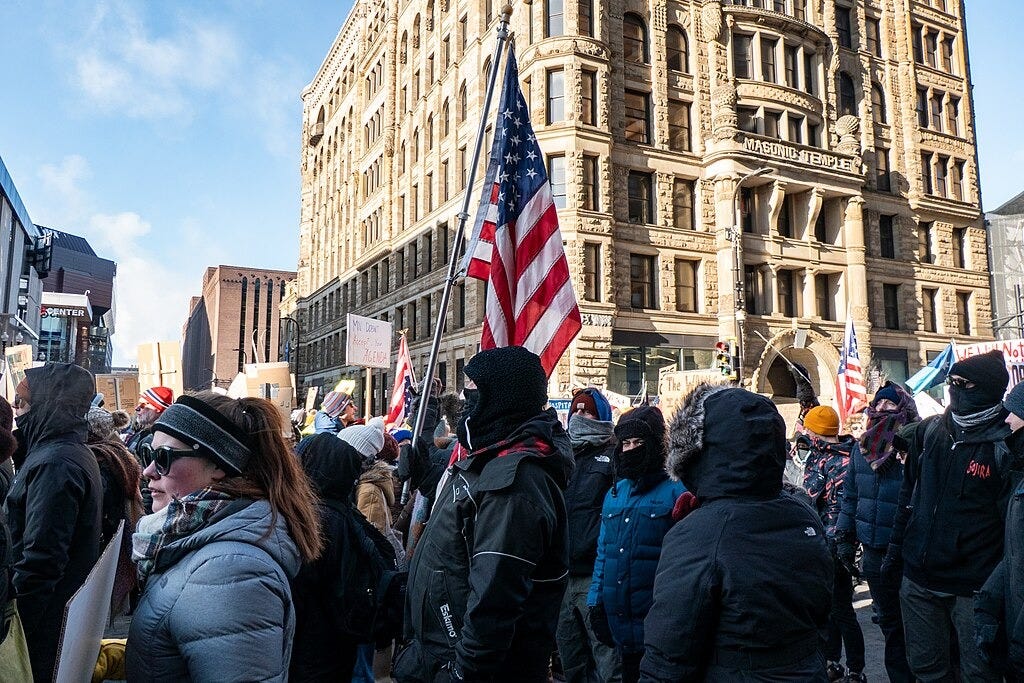
It should be obvious how important it is for us to remember this right now, as roving hordes of military-armed harassers with government badges are on the streets. What is happening in Minneapolis is happening on a smaller and less visible scale elsewhere: a non-democratic “security” regime seeking to enforce its will on a vulnerable population. But what is happening also in Minneapolis is an authentic democratic response by ordinary citizens, acting with vigilance on behalf of themselves and their neighbors. Democracy is making Minneapolis safer and better.
The surfer who told of his near-death experience, of course, came up to the surface of the water and recovered his breath. He lived to surf again. I hope something like that is happening currently in many parts of this country with respect to democracy. If we lean into democracy, we will be safer and better.