

I’ve only been subjected to two oral examinations in my life. The first was a minor disaster. I was defending what I hoped would be my right to be awarded a Master of Arts in Literature and Rhetoric. Having spent most of my M.A. studies focused on the latter, Rhetoric, I had every expectation of an M.A. oral defense focused on Sophists, Aristotle, Cicero, Erasmus, Kenneth Burke, and other luminaries of what is sometimes styled “The Rhetorical Tradition.” Instead, I got an oral exam mostly devoted to Literature and had to improvise my way through questions about Sir Philip Sidney, Shakespeare, Marlowe, Hawthorne, and Wallace Stevens. I was clearly struggling, so my exam committee threw me a softball, asking “Who in the American literary canon would you argue does not belong there?” It took me a few seconds to formulate an answer, but then it came out as “Ralph . . . Waldo . . . Emerson.”
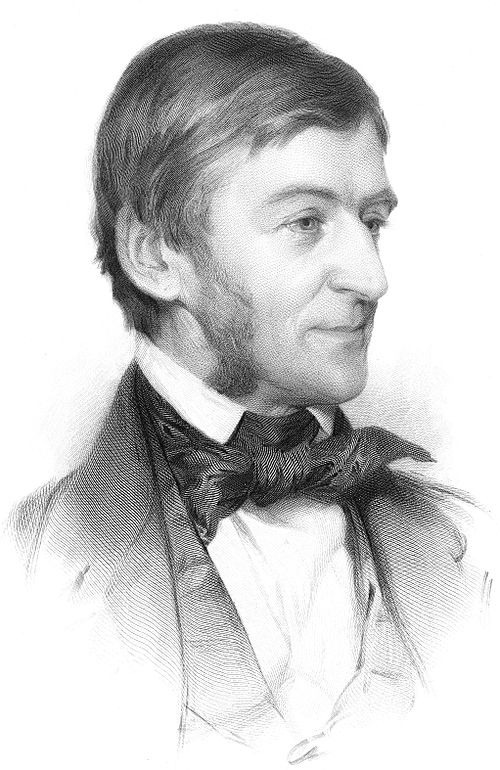
Emerson (1803-1882) was the most influential U.S. writer of his age, co-founder of The Dial, renown circuit speaker, and, most importantly, author of a series of literary and philosophical essays published in the 1840s under a title only the most eminent writers can use, Essays (okay, more specifically, Essays: First Series [1841] and Essays: Second Series [1844]). These essays included now-famous works like “Nature,” “Circles,” and “Self-Reliance.”
Still, it was not all that hard for me to justify my answer to my examination committee. Emerson was out of fashion in literary studies back then. Moreover, two of my 19th-century American literary heroes, Nathaniel Hawthorne and Herman Melville, shared a common distaste for Emerson. Among Hawthorne’s many writings is a little satire called “The Celestial Railroad,” a riff on Bunyan’s Pilgrim’s Progress where Hawthorne pokes fun at Emerson and other Transcendentalists for their incomprehensibility: “we knew not what he meant, nor whether to be encouraged or affrighted.”
Melville also took his ink-blade to Emerson. In Pierre (1852) he wrote of a popular philosopher named “Plotinus Plinlimmon,” an allusion to Emerson’s overwrought Neo-Platonism, and implicitly impugns Emerson for his hypocritical asceticism. And then, in “The Masthead” chapter of Moby Dick (1851), we read of “romantic, melancholy, and absent-minded young men, disgusted with the caretaking cares of the earth, and seeking sentiment in tar and blubber”—a reference to Emerson’s penchant for refusing the mundane in favor of Big Thoughts.
I still draw near to Hawthorne and Melville—Melville especially—but lately I have been coming around to Emerson, or at least parts of the Big Thinker. I have warmed up to his Neo-Platonism (though credit here goes above all to Terrence Malick). And more and more, I think Emerson was right all along about the ecological epicenter of modernity.
And lately I have been thinking a lot about his appeal to “Self-Reliance” as a needed democratic virtue.
Rethinking Emerson himself has been part of a more general reckoning I’ve been having with the reality of contradiction as a feature rather than a bug of modernity. I am trying to learn how to say both No and Yes to the world as we know it, and in the very same paragraph—an Emersonian specialty. As things grow darker and bleaker in one orb, I am trying to exercise my spirit in ways that see what is light and good in other orbs. This feels to me a critical exercise in staying connected to the primal reality that transcends the capitalist virtual reality that is consuming our society.
My draw to Emersonian “self-reliance”—or what he also calls “non-conformity”— has to do as well with living amid the breakdown of major institutions that, for me at least, appeared for a time to be worthy of their name, namely the Church, the University, and Government. For me, the Church has long been a way in which I have tried to stay connected to primal reality. But in light of abuse scandals and “Christian” leaders who defend violence and cruelty (not to mention defending a President who poses as Jesus), I am finding myself repeating Emerson: “but in Christendom where is the Christian?” As for the University, the utter failure of character, the lack of imagination and courage, and the technocratic bean-pushing, is really quite stunning, so I return to Emerson: “Character is higher than intellect. . . . A great soul will be strong to live, as well as strong to think.” As for Government, well.
I still love my little church. I still teach at a major university. And I still care deeply about the quality of governance. But it is clear that the old un-thought-out orthodoxies are failing us, be they political, constitutional, economic, religious. Some still refuse to believe that. Some are too distracted to notice. Others dream of a great revival of what has receded, but what really are they eager to restore? What in our lifetimes can we point to as truly worthy of such reconstruction? And what from further back is tailor-fit for an age that seems to want nothing more than to run itself into the ground with automation, virtuality, and profit maximization?
Emerson helped create an American tradition of “non-conformity,” or of thinking otherwise. His ethic of “Self-Reliance” turned the 19th-century Protestant ethic into a way of saying No as well as saying Yes.
Woven into Emerson’s tangled sentences are arguments—sometimes explicit, sometimes implicit—for abolition, ecology, egalitarianism, anti-imperialism, and a certain democratic cosmopolitanism. The hinge-point of the “Self-Reliance” essay (more like a sermon) is, well, “self-reliance,” a notion that has often been interpreted as meaning “individualism.”
But Emerson certainly could not have meant “individualism” in any strict sense. His was not Benjamin Franklin’s or Henry Clay’s “Self-Made Man,” or Frederick Douglass’s for that matter. Rather, Emerson’s world was a world of interconnections, a network of links, a web of interdependencies. Reality for him was composed of parts linked to wholes and wholes that give way to parts. While Emerson praised modern science, and some have taken him to be offering an essentially “scientific” account of the world, I have a hard time seeing in his philosophy anything like the modern scientific truism that the world is composed of simple bits or atoms. There is rather an irreducible living complexity to the primal quality of the world—the ground of the universe is the living Whole, not mechanical parts.
In important ways, the Emerson of “Self-Reliance” reminds me of my long-time intellectual and political guide, Hannah Arendt. Her attitude toward the past was far less dismissive than Emerson’s, but she was persuaded that the old orthodoxies could simply not hold the weight of late-modern society. We—you, me, us—needed to learn to think anew for ourselves. What Emerson called “Self-Reliance,” Arendt called “Thinking without bannisters”—that is, thinking without pretending the old traditional handrails can fully support us.
“Self-Reliance” is an exhortation for Americans to be better, but it is also a criticism of the handrails 19th-century White Americans used to prop themselves up. His target was not “tradition” in the sense of Aristotle or Aquinas, Federalism or Republicanism, democracy or free speech, but rather what he identified as Piety, Party, and Property. Piety makes us feel good and sufficiently righteous, protecting us from reality. Party makes us feel not alone, but also tempts us to conform. And Property protects us from the honest measurement of the actual moral worth of things. Too many Americans, he complained, “measure their esteem of each other, by what each has, and not by what each is.”
Emerson also recognized the pathology of a technological society. Rather than assuming the “good” of new technologies, he contemplated first their potential harms. He doubted that the grand narrative of “progress” we tell ourselves was really true: “Society never advances. It recedes as fast on one side as it gains on the other its progress is only apparent, like the workers of a treadmill. . . . The civilized man has built a coach, but has lost the use of his feet.”
Finally, he was keenly aware of the oversized role that envy, imitation, and conformity play in American capitalist society. He urged his readers to stop looking around at everybody else and instead be yourself: “Insist on yourself: never imitate.” While such a categorical statement is poor advice for any kind of learner, or indeed for any kind of basic social cooperation, “Insist on yourself” has within it the seed of a vision of full human maturity. Envy can corrupt us. Imitation can empty us. Conformity can kill us.
Cornell West puts Emerson at the source of one stream in the American prophetic tradition. In this stream, as West writes, “existential integrity and personal moral authority trumps theoretical veracity and impersonal ethical doctrine.” In other words, if we are to become mature adults, full citizens, or noble neighbors, it will not be through conformity to pre-packaged “worldviews” or “lifestyles” but through taking responsibility for ourselves.
I am still not ready to drink from the Emersonian stream with abandon, but a country in crisis could do worse than reconnect with a person who taught,
If you maintain a dead church, contribute to dead Bible-Society, vote with a Great Party either for the government or against it . . . I have difficulty to detect the precise man you are. And, of course, so much force is withdrawn from your proper life. But do your thing, and I shall know you.
So, do your thing! It will help.