

I am at an academic conference this week where I have been graciously invited to make a few comments on John Dewey’s The Public and Its Problems (1927), a 20th-century classic in political theory. My comments, offered below, are not so gracious, but they reflect genuine concerns I have about what higher education became in the 20th century.
For those who may recognize the name but struggle to recollect much about the man, John Dewey (1859-1952) was a philosopher, educational theorist, and psychologist. He’s most famous today for the Dewey Decimal System, which was not his at all but Melvil Dewey’s. John Dewey’s association with it is ironic, for Dewey was not much interested in minutiae—he was a big, broad, and ambitious thinker ready to write about the biggest problems facing humankind.
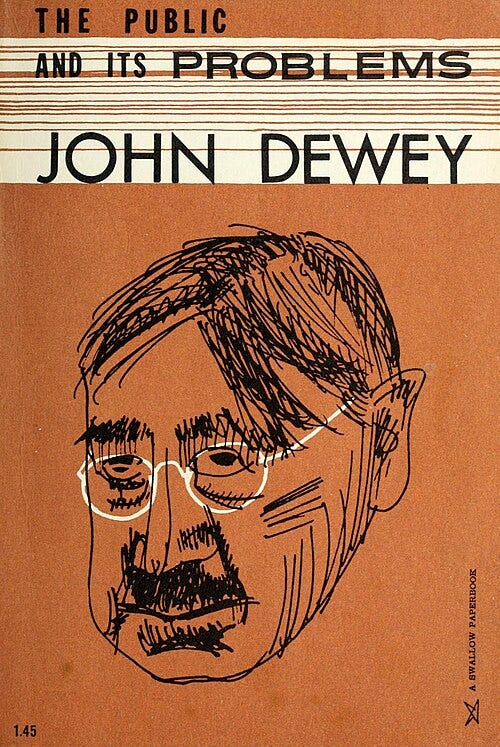
The Public and Its Problems was one of many books he wrote, but it remains today one of his most enduring texts. A small academic industry has taken shape around “the problem of the public.” What is the problem with the public? The questions vary. Is there a “public,” or are there only fleeting publics that come and go? What conditions are necessary in order for “the public” to be formed, to be powerful, to be accountable? And is “the public” equipped to handle the complex issues of contemporary society?
This last question is very close to Dewey’s in The Public and Its Problems.
A couple of years ago I wrote a high-flying academic history about The Public and Its Problems that was published as a journal article. This week at the conference, as part of a panel, I’ve been asked to give a short “comment” on the legacy of The Public and Its Problems. What follows is an edited version of those comments.
By way of preview, my comments concern higher education: I suggest that Dewey is at least partly responsible for the evolution—or devolution—of universities into training grounds for “experts.” To be clear, this is not an anti-expertise screed on my part. Rather, it is an engagement with the question of the purpose of higher education. Are we training learners or are we training an aspirational ruling class?
Comments at the National Communication Association:
I am here to think about what Dewey did with his thinking, how his ideas helped form a kind of ideology, an ideology of expertise that has supported the aspirations of a new kind of political aristocracy. Some of what I will say here resonates with certain critiques of expertise with regard to the university that have been forged on the political Right at least since the days of James Burnham’s The Managerial Revolution (1941).
Let me therefore say out loud: that’s not where I am coming from. Rather, the energy here is egalitarian.
My concern: John Dewey did not quite mistake the university for a polis or civitas, but he helped us make it a kind of aristocracy.
Some of us, by contrast, are in the university just for the ideas, the learning. We think that politics is far better served on the streets, in the city council, in grassroots campaigns, voting booths, petitions, or vertical screen appeals than at academic conferences or peer-reviewed scholarship.
I don’t blame John Dewey alone for mistaking the academy for an aristocracy, but I do think he bears significant responsibility for this widespread, if often tacit, assumption.
My friend Chad Wellmon has just published a book called After the University. It is not so much a swan song for higher education as it is a call—rooted in a level of historical knowledge about higher education that few of us could imagine having—for the university to learn to love the ideas again, to trumpet the pain and pleasures of learning itself. Let’s call it higher education as the pursuit of intellectual virtue.
Chad, in a recent talk, recounted the story of my own university, the University of Illinois: Over a century ago we formed a vision of a form of higher learning that, if successful, would leave young people invigorated and ready to go back to their communities with ideas, methods, and practices that could enrich homes, serve local governance, bolster local education, feed the local economy, and lift up local culture.
That’s what the University of Illinois thought it was setting out to do at the end of the 19th century. But we did something very different. Instead of sending students back home, we equipped them to leave the university and go to Chicago, or Washington D.C., or Springfield, or graduate school—and if they came back to their communities they came back as experts dropping in to tell their almost-forgotten neighbors how to do governance, education, economy, and culture.
I do blame Dewey for this. Not him only, but him.
Consider this quotation from The Public and Its Problems, one of a number like it:
The ramification of the issues before the public is so wide and intricate, the technical matters involved are so specialized, the details are so many and so shifting, that the public cannot for any length of time identify and hold itself. (p. 137)
I understand the problem Dewey is identifying here: things are complicated, modern society is intricate and perplexing—perhaps even incomprehensible.
Point taken. But this is not a peculiar problem for “the public.” We only need to consider the dumb-founded-ness of the Trump administration before the fluctuations of markets, wars, plagues, and politics to see the obvious complexity of things. But Trump Inc. is too easy. We can look at the history of any presidential administration to see how illegible modernity has been to those who govern. “Whiz Kids,” anyone? The “Best and the Brightest”? No less dumbfounded by modernity than Trump’s lap lickers.
That’s my point—things are complicated, modern society is intricate, the world perplexing . . . to those who govern. To “experts.” To me.
Dewey’s point, however, was different. It was that modernity was illegible to the public—that is, to the masses of ordinary folk—but that it could be made legible to expert administrators, those college graduates that “return” to their communities by dropping in and explaining to the farmer, the grocer, the elementary school teacher, or the pastor the “best practices,” the latest scientific research, peer-reviewed priorities. We do this because the public cannot “identify and hold” itself. They are too small and/or fragmented, the problems too big and encompassing; the public is too distracted, but the problems need exacting attention.
The fact is that the only person who can critique “the public” as such is the person who is removed from it, above it. Here we are talking about the man of “higher education.”
And the only person for whom the public is a “problem” is the expert administrator.
But the epistemic and psychological problems that Dewey identifies in The Public and Its Problems—the issues are so wide and intricate and technical and detailed—are in fact just as much problems for expert administrators as they are for ordinary Joes. The problem is with modernity—and now hyper-modernity—not the public. The belief otherwise creates the pretext for a new aristocracy—a political structure erected on an epistemic premise—wherein the public, or publics, must be ever left subordinate.
The Dewey-inspired culture of expertise has fooled us into believing that the academy really matters politically. Universities, we think, are epicenters and engines of political change—for We the experts! We can “identify and hold” ourselves; the public can’t.
As such, the Deweyan project outlined in The Public and Its Problems has been a boon for aspiring elites, but a failure for so many communities. And I think it fair to say that the public now agrees.