

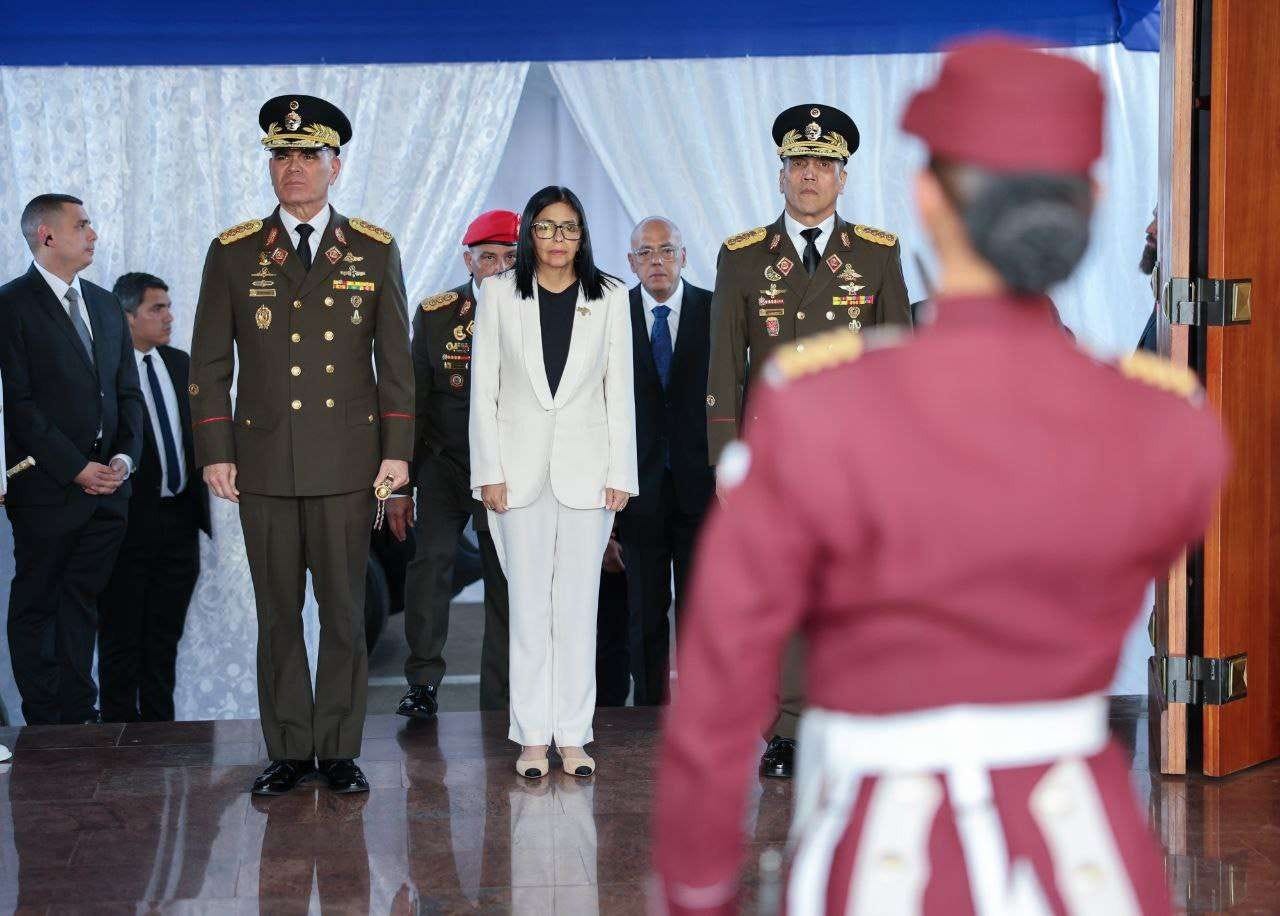
The new Venezuelan leader, Delcy Rodríguez, is scheduled to visit the White House today.
Rodríguez was Nicolas Maduro’s Vice President, and a full participant in the corruption and dictatorial cruelty of her predecessor. What is the United States doing entertaining at the White House a representative of a Leftist dictatorial regime they just decapitated?
A thought: Perhaps Trump’s dealings with Venezuela have nothing at all to do with “regime change.” Perhaps we need to be thinking instead about “clique change.”
Last April, I wrote here at Civic Fields of “The New American Royalism.” My argument then (before the rise of “No Kings!” protests) was that it was not quite right to call Trump an “authoritarian.” Instead, as I wrote,
We are witnessing a form of American Neo-Royalism. It’s American because it comes out of a mash-up of American messianism, hero-worship, celebrity culture, imperialism, and Constitutional ambiguity around the limits of executive power. It is Neo-Royal because it centers on a form of courtly politics.
There’s been a lot of talk about Donald Trump’s authoritarian instincts. I take this talk seriously. It is not an overreaction. But it is in important ways a misdiagnosis. The truer thing to say is that Trump wants to be, and in a certain sense already is, king. To be sure, he has no throne. But kings don’t need thrones. The only thing monarchs absolutely need is a court, and that is what Trump has built for himself, first by dramatically transforming the power-dynamics of the Republican Party into a dynasty project and now by shaking the rickety bones of our republican Constitution to satisfy his unquenchable need to be at the center of things.
My argument, in short, was that a political system was developing around Trump that looked very much like the political systems that existed for centuries in Europe, in and around monarchs—a courtly system of competing clients, each vying for Trump’s attention and beneficence. This, I suggested, is different from a straight-up authoritarian system. In the latter, power is wielded strictly through force. In the courtly or royal system, it is wielded through favors and flattery, too.
Recently, a couple of political scientists have taken the idea of American Neo-Royalism into international relations. In an article that appeared this winter in the journal International Organization, political scientists Stacie Goddard and Abraham Newman argue that the Trump administration is approaching international power in a way that reinvents an old royalist approach to international relations.
Needless to say, I think what these scholars argue makes a lot of sense, and makes sense of the Trump administration’s seemingly erratic international dealings. Looked at through the paradigm of "Neo-Royalism” they in fact don’t look all that erratic at all.
Here I am going to summarize for you the argument Goddard and Newman make, and then reflect on Trump’s recent actions in Venezuela in light of their argument.
Goodard and Newman argue that the Trump administration is trying to create a new international order, “Neo-Royalism.” This order, they argue, has already been championed over the last decade by the likes of Vladimir Putin in Russia, Viktor Orbán in Hungary, Narendra Modi in India, Recep Erdoğan in Turkey, and the various kings and leaders of the Gulf States. But the Trump administration, they argue, is in a unique position: As leader of the world’s only real superpower, Trump is able to use U.S. power to push Neo-Royalism into global rather than regional dimensions.
So, what is Neo-Royalism as an international order?
The answer starts with what it is not. It is not a system based on nation-state sovereignty. That is, it is not part of the old “Westphalian Order,” which, in the words of Goddard and Newman, “rested on the legal recognition that sovereign states maintain exclusive control within their boundaries.” Nor is Neo-Royalism an extension of what political scientists call the “Liberal International Order,” which adds to the Westphalian Order an emphasis on rules that are upheld and enforced by international institutions.
Neo-Royalism wants to replace both these historic systems. How and in what ways?
First, Goddard and Newman argue, Neo-Royalism is not organized around states, nations, or even institutions, but around what they call global “cliques”—small groups of “hyper-elites” bounded by “their connection to an absolute sovereign.” These networks are vertically rather than horizontally organized, centralized rather than distributed.
These cliques of hyper-elites are by their very nature highly exclusive, keeping out not only “commoners” (you and I) but many elites who, for one reason or another, are either not able to access the sovereign’s attention or are not in his or her good graces.
If it helps, we are not all that far off here from high school, where cliques of “cool kids” police the boundaries of social power and vie against each other for influence. But here, the cliques are operating on an international scale, have armies at their command, and are as much interested in economic power as social power.
Let me stress something here: Goddard and Newman argue that these cliques “extend across territorial boundaries.”
That is, they are not national or nationalist, though they frequently use the rhetoric of nationalism to prop themselves up. Rather, they represent a small network of international global hyper-elites. Goddard and Newman, for example, mention the connections between Trump and his family to Rupert Murdoch, Peter Thiel, and Erik Prince. Together, these global hyper-elites are “playing strategic games unbound by national borders or Westphalian systems of [nation-state] political ordering.”
Neo-Royalism relies not on rules, but on personal power and “personalist pleas.” When Trump receives a call from a foreign leader, or a CEO, or a social media influencer, he interacts with them not as an “office holder” with particular duties to observe, but as Trump, the man, the personality, and the sovereign. His “transactional” dealings, as they are often called, in fact fit perfectly the older pattern of kings who extract “rents” or “tributes” from clients.
Similarly, the use of force, or threats of the use of force, are not used as actions taken in defense of the nation, but as personal moves against persons who, for one reason or another, have crossed the clique or its leader.
Goddard and Newman write,
This is not liberal cooperation [liberal in the classical sense], but instead is much closer to the type of collaboration [and aggression] practiced in oligarchic and mafioso systems and protection rackets. Leading cliques engage with local cliques in a process of distribution, in which they leverage threats, promises of access to the inner circle, or status recognition to maintain their hierarchical positions.
Think here of virtually any mob movie you’ve watched. This is how power works in Neo-Royalism.
Finally, the authors argue that Neo-Royalists depend for their “legitimation”—a political-science term for the right to rule—not on providing public goods for the state or its people (e.g. security or prosperity), let alone on democratic sanctions, but on “stories that explain why some actors are uniquely endowed with the right to wield sovereign power”—be it “God’s will” (i.e. the neo-divine-right thinking we see among many sectors of American evangelicalism) or “genius” (a claim Trump makes about himself frequently, with questionable justification, but which the tech-bros also make with more justification).
Goddard and Newman say more, and at more length. But this is the gist of their insightful article.
So, what about Venezuela?
One thing that Neo-Royalism opens up on the world stage is personal wars among elites. In the frame of Neo-Royalism, what happened on January 3 was not an attack by the United States on a foreign country in the service of national interests, but a much more personal attack by Trump, using the U.S. military and the CIA, on another person, Maduro, in an act of personal retribution.
What did Maduro do to become Trump’s personal target? It’s a good question, but if the Neo-Royalist thesis is correct, we should not be looking for an answer in the “national interests” of the United States, as if Trump is playing a global Westphalian chess game, but rather in those networks of warring global cliques that are currently dominating the world stage.
Clearly, Maduro had ties to Putin, Xi, and Khamenei, the Supreme Leader of Iran. But so do many world leaders. So what gives? Maduro’s crime may have been exercising those ties in Trump’s international backyard. The so-called “Donroe doctrine” may represent an attempt to organize the international clique system along hemispheric lines.
The Trump administration seems to be for now throwing its weight behind Maduro’s right-hand aid, Delcy Rodríguez. Replacing one Leftist authoritarian with another makes little sense within the frame of the Liberal International Order, or from the perspective of Westphalian national interests.
But it does make sense within a Neo-Royalist frame.
That is, in Venezuela we may not be looking at a “regime change” (a very Westphalian way of looking at things) but rather at a “clique change.”
The message Rodríguez may be getting upon her visit to the Trump White House today: Welcome to the Donroe racket. Join or die.