

In 1958, two Navy men published a novel, The Ugly American, that argued that the United States was making all the wrong moves in international diplomacy. Rather than winning the world over through humble sensitivity to others’ needs, cultures, and struggles, the United States was putting on full display its insensitivity, ineptitude, and at times outright brutality. The novel caused a sensation and helped motivate President Kennedy to launch the Peace Corps.
To say the least, this has been an ugly week for the United States of America. The lawless Iran war runs on. Gas, diesel, and long-term bond prices are approaching historic highs. And President Trump stood before the United Nations a couple of days ago and threatened to “annihilate” Iran, even as he boasted of the U.S. stealing Venezuelan oil. “To the victor belongs the spoils,” he told the U.N. General Assembly. What an ugly man.
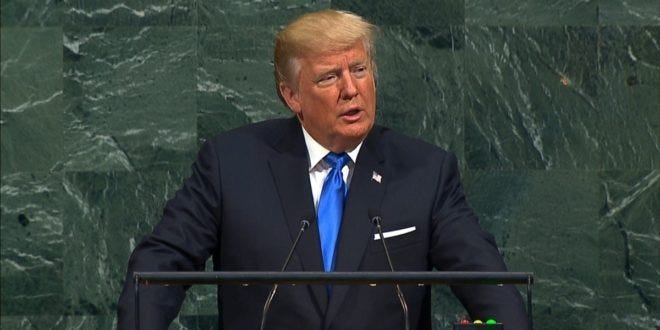
But we knew this all along. Trump’s ugliness is part of what got him elected twice. The question is how are Americans to deal with this ugliness, comprehend it, confront it?
This week the journalist Anne Applebaum published an article called “Empire of Grift” in The Atlantic magazine. When the cover story arrived at my doorstep (yes, I still subscribe to print versions of magazines), I had high expectations of some hard-nosed reporting on recent developments in Trump’s aggressive privatization of American foreign policy. I had good reasons for high expectations: Applebaum is a well-respected journalist in American foreign affairs and author most recently of Autocracy, Inc.: The Dictators Who Want to Run the World. I expected in “Empire of Grift” a sequel of sorts to Autocracy, Inc., an update on how the Trump administration is perfecting the practice of profiting off the backs of citizens.
Instead, the article mostly rehearses what has already been widely reported: the Trump administration is full of grifters; they are quite friendly to the global hard-Right; they don’t mind mixing their own profit with politics; and they are happy to interfere in the affairs of other countries to keep or return autocrats to power. There is little “news” in the piece, if we mean by news something new.
Instead, the article is a kind of morality tale: here’s what happens when you let amateurs and kooks capture power.
More broadly, Applebaum tells the story of America’s Great Fall from historic liberal principles. The age of American benevolence is over.
To characterize this Fall, Applebaum uses the language of “revolution,” even citing Karl Marx. She argues that what the Trump administration is doing is not only unprecedented in U.S. history, but a radical and irreversible change of direction, a revolution.
American Power is no longer deployed, solely by trained diplomats and reliable officials, working through state channels. Informal envoys, private companies, online grifters, and hardened ideologues both inside and outside of government matter more.
I have been noticing similar stories circulating in outlets like The New York Times, NPR, PBS, and other liberal or liberal-leaning news venues. For whatever reason, liberal elites seem to have decided in the last few months that the post-World War II U.S.-led international order really is done for and we are entering a dangerous and potentially wildly out-of-control new world. America has fallen from its heights.
I do not dispute the forecast, but as a historian who cut his teeth on the Cold War, I have been so very perplexed by the premise that, as Applebaum writes in her article this week,
For decades, we have told ourselves that our country represents democracy, freedom, and free trade. We believed we had allies, like-minded nations to share these values. We thought we opposed dictators and kleptocrats, the leaders who steal from their own people. What happens when we realize that we no longer do?
Does she not know that the United States has long interfered in the affairs of other nations, using invasions, gunboats, mercenary forces, covert actions, psyops, and outright coups to install brutal authoritarian governments, sometimes in place of democratically elected ones? Does she not know that the interests of American corporations were sometimes partners in these efforts, sometimes driving them?
Applebaum further writes,
America helped build eight decades of peace, prosperity, and eventually democracy in Europe and much of Asia, creating markets for U.S. companies and unprecedented support for U.S. power. This world is fast disappearing.
Does she not know that between World War II and 1990, more than 20 million people were slaughtered in violent conflicts in Asia and the Middle East, most of them civilians? The United States was not responsible for all these conflicts, but it did have a direct or indirect hand in most of them, quite frequently exacerbating the bloodshed.
Doesn’t she know about the Ugly American?
To be sure, the post-World War II global order has been quite good to the residents of the United States of America, as well as to some American allies. But that order has hardly been premised on unqualified support for democracy, free trade, or opposition to dictators. Rather, U.S. led post-World War II international order was one that justified, when expedient or seemingly necessary, the malign use of state power to support causes, men, or positions that defy the dictates of democracy, freedom, and free trade. “To the victor belongs the spoils” has indeed been a creed sounded before in the halls of American power.
A few weeks ago I wrote of the importance of national narratives. The narrative now widely circulating among liberals in elite or elite-adjacent circles is one of a radical rupture from historic American practices and values. The Great Fall narrative. It’s fast becoming part of a liberal piety.
I have a different narrative.
What is actually happening looks to me like a Freudian drama unraveled.
The American Id—the collective American unconscious that demands gratification no matter the cost—is now on stage of consciousness, making big and bad decisions in the drama of American power.
All the while the American Superego—that parental voice of ideals and rules—is being (literally) kicked out of the White House and pushed to the pages of magazines like The Atlantic, newspapers like The New York Times, and cable channels like MS Now.
In between these two warring parties sits the beleaguered American Ego—beleaguered because it does not know what is real or true, and therefore cannot decide between the Id and the Superego.
Trump tells us the American story is all about acquisition and exploitation—that is his notion of American Greatness. The current liberal punditry tells us that this is an alien American narrative, a betrayal of the true American story of democracy, freedom, and prosperity. Trump’s narrative is insidious, but the liberal narrative feels hollow to me.
Indeed, part of the crisis of liberalism today—where “liberalism” is understood as the ideal of a rules-based free society—is found in the inability of many liberals to squarely recognize those parts of America’s past that have been so manifestly and profoundly illiberal. It is the flip side of the problem with the liberal narrative a half-decade ago: then American history was condemned to the dredges of white despotism, today it represents a bygone age of international benevolence.
There are so many stories we could tell about this country and its role in the world that do not presume either American innocence or total depravity. If we need a meta-narrative—an overarching story—it needs to be about a broken nation trying to repair itself.
We need not stories of either/or but of both/and: stories of betrayal and repair, of stolen and reclaimed birthrights, of struggle and solidarity, of quest, agony, refusal, opposition, defiance.
The American Id has always been there, not the least in the postwar order. The Superego for a long time gave Americans the occasion to tell themselves that the Id’s voracious violence was not really American at all. But in the age of Trump that’s becoming a quite hard story to tell, and so liberals in high places are now telling a story of a Great Fall.
For me, I’d rather approach the present as an occasion to stare the Ugly American in the face and recognize him as a creature of the American past as much as the present . . . and then say something nasty to him.