

Want to create a national park? Last week, I had the privilege of spending a few days in Mississippi learning from people who did just that. In 2023, the Emmett Till and Mamie Till-Mobley National Monument was created as part of the U.S. National Park Service. It has sites in the Mississippi Delta and in the city of Chicago. You can visit today if you wish.
How this park was created is what fascinates me and is part of the reason I went to Mississippi last week. It’s a fine example of the power of a politics without enemies.
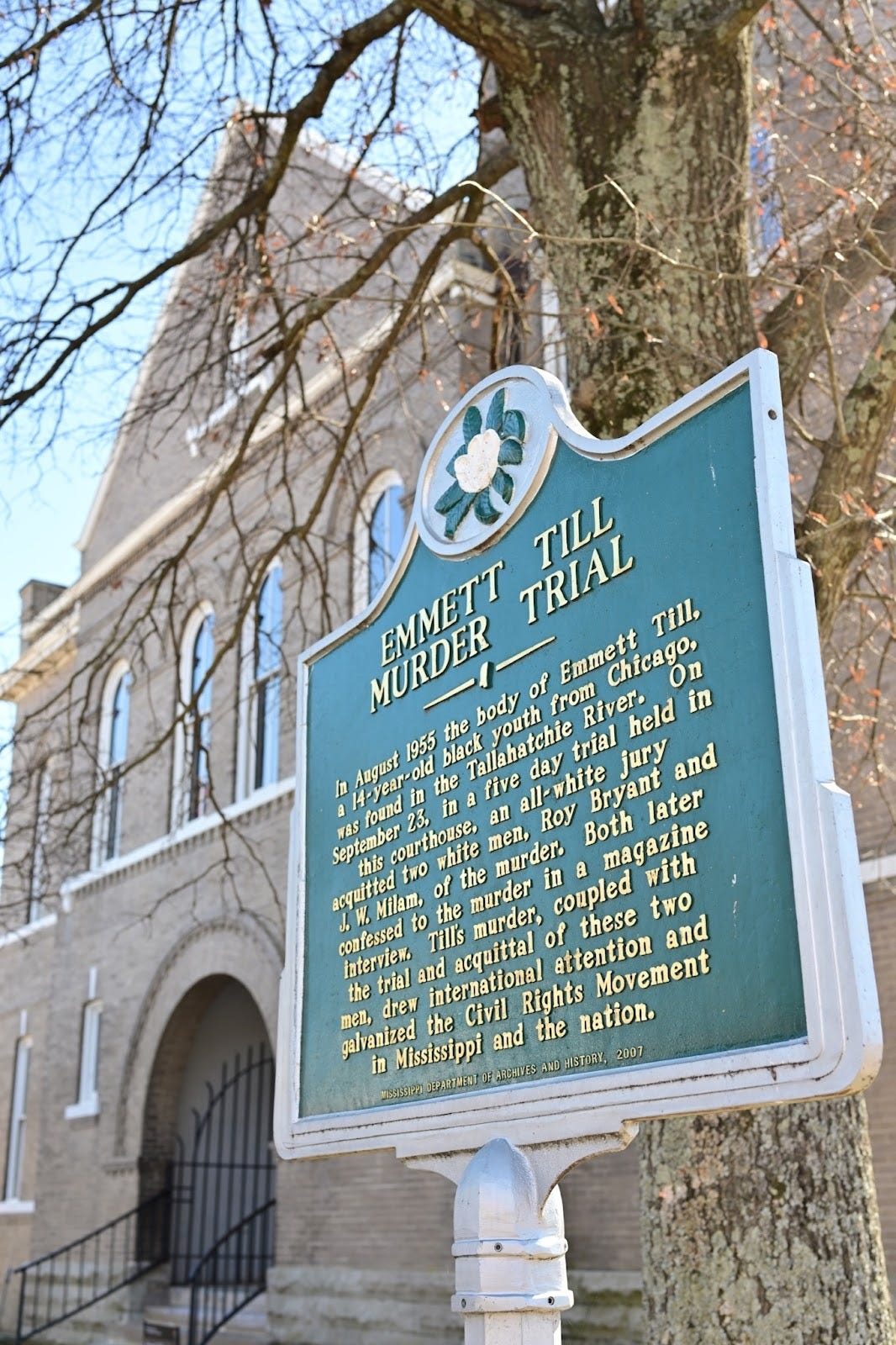
The park is the work of a group of ordinary Mississippians, both black and white, who worked in cooperation with some folks from Chicago. Together, they strove for two decades to ensure that the memory of Emmett Till and the racial violence to which he was so brutally subjected in 1955 would be officially remembered. Just as we have lionized the signing of the Declaration of Independence by making Independence Hall a National Park, so, they believed, we need to lament the long history of racial violence in this country by making monuments out of the sites where the injustices that followed Till’s murder were executed or grieved: the Sumner courthouse where Till’s murders were acquitted despite overwhelming evidence, the site where Till’s body was pulled from the Tallahatchie river, and the church in Chicago where Till’s funeral was held.
Here’s what’s remarkable, though. These folks did this in the state of Mississippi, a state that has until very recently stubbornly held onto its Confederate symbolism, a state that still celebrates the “Rebels,” that still clings to the structures of white power. On top of that, these folks did it with relatively little in the way of public resources or big-time political support. And they did it in a political context notorious for race-tinged culture-war convolutions.
In my book Politics for Everybody, I devoted a whole chapter to “political miracles.” The Emmett Till and Mamie Till-Mobley National Monument is one of the great political miracles of recent American history.
Mississippi may be our best national emblem of the harm extractive industries and massive wealth inequality do to a people. For a small minority of Mississippians, wealth is great. For a larger number of suburban whites, purchasing power remains strong. And yet the majority of Mississippians either live at the subsistence level or dangerously close to it. Mississippi is the poorest state in the union, and outside of Oxford or the suburbs of Jackson and Hattiesburg, it shows.
There is still in Mississippi today a Gone-with-the-Wind-style culture centered on the careful cultivation of manners, the idealized white female form, and cultured southern traditions that are incomprehensible to outsiders.
At the same time, the historically fertile soil of Mississippi has been literally stripped of its riches through the massively extractive economy of cotton. Mississippi is 85% of the size of the state of Illinois, where I live, and far more rural. Nevertheless, despite Mississippi’s great delta floodplain, its agricultural production does not even approach half that of Illinois. To drive through the delta today is to see acre after acre of land that has been beaten and bruised. The level of human poverty in the Mississippi delta today competes with places like Haiti and Cuba. Jackson, the state’s capital, is notorious for neglect. There have been parts of the city recently where sewage runs out onto the streets for days and where drinking water is scarce.
To visit the power centers of Mississippi, however, is to be met with white tablecloths and crystal glasses. It is to encounter a world where everybody seems to know everybody else, where business is done with a handshake or pat on the back, and where “back-room deals” are just deals. Mississippi is a place where, politically speaking, nothing is straightforward, at least not if you are an outsider. You have to learn how to jump through not just hoops, but pretzeled ones. The more shape-shifty you are, the more you might be able to get done.
But the people who created the Emmett Till and Mamie Till-Mobley National Monument are not shape-shifty. They are just salt-of-the-earth savvy. And they definitely know how to get things done, even in the state of Mississippi.
Yet, these are not powerful people, not at least in the sense of major movers and shakers. These are culture-shifters who defy the model that tells you that to have real political or cultural power, you have to be an elite or an influencer.
Most of them are black in a state where white people have worked long and hard to keep blacks in their supposed “place.” None of them have degrees from Harvard or Stanford. None of them are super rich. And yet, they’ve managed to build something, something that people wanted, something that will last for generations.
I could write a short book on lessons we could learn from them. Maybe someday I will. But what stuck out to me most was that these were people who refused to have enemies.
Theirs is a politics without enemies.
When I say “without” here, I do not mean “absent from,” as if there are no people who oppose them. Quite the contrary, the opposition was fierce, even violent. Rather, what I mean is that these folks refuse to operate according to the political logic so dominant today of “friends versus enemies.”
There is nothing naive or Pollyanna about this, or about them. These are people devoted to the Good, Hard Work of racial and economic justice. They are Truth Tellers—no beating around the bush with them. They are fighters, fierce in their commitments.
And they are builders. Unlike so many “builders” in our society today—I am thinking of the Tech Bros—these are builders who build things people actually want, even need. The Emmett Till and Mamie Till-Mobley National Monument is more than a needed memorial; it is an economic ignition switch for the Mississippi Delta. These builders know that.
The only things they seek to destroy are lies.
But, at the same time, these are also people who chose not to alienate the political and ideological opposition.
We may not think this way, but the fact is that having political and ideological enemies is a luxury that many of us can afford. But when the odds are starkly stacked against you, you can’t easily afford enemies. You have to learn the art of converting opponents into at least provisional political friends.
For example, the courthouse in Sumner, Mississippi, in which Emmett Till’s murderers were tried and acquitted, is at the center of the new national park. Not that long ago, it was falling apart, ready to crumble to the ground. The powerful white landowners in and around Sumner had little to no interest in saving the courthouse for the sake of remembering Emmet Till. Some of them were utterly opposed to anything Till-related in Sumner, and not because they just wanted to let the past be past, but because they are still today committed white supremacists, believing in the superiority of the white race.
But the folks building the national park were able to convince these opponents that if the courthouse crumbled down, so would the legal industry in the town of Sumner and in the county of which it was a part, Tallahatchie. Legal business would move away to a nearby county. And if there was one thing well-off white landowners want, it is lawyers. So, a compromise of a kind was reached. The folks behind the Emmett Till memorial would help raise money to renovate the courthouse, and the powerful white landowners would permit it—the latter to serve their own interests.
It’s not pretty, but it’s savvy and good. I am writing about a national park in Sumner today because these folks refused to let enemies just be enemies—they worked to make them political friends, temporary allies, on behalf of a common end.
Different motives, but a common end nevertheless. Can you imagine?
To get anything of any significance done in Mississippi, especially in and around the delta, you have to work with the white landowners and the Republican establishment that protect them. There’s just no other way.
So the ideological purity tests have to be thrown out. Politics has to become not a means of separating friends and enemies, us versus them, but a means of refusing to have enemies.
It’s the way to get things done that people actually want.