

It is one of the guiding maxims of Civic Fields that the biggest splits in American political culture are not between Right and Left but between more fundamental factors. It is a modern myth, born of the French Revolution and its aftermath, that the bottom layer of politics is ideological. The French Revolution—especially the reaction to it—did more than reduce politics to “sides.” It taught us to believe that those sides are fundamentally defined by worldview, belief systems, or idéologies (a word, by the way, coined in France during the Revolution by those trying to bring the French population under their control).
Since the 1990s, under the fraudulent power of the culture wars, the belief that politics hinges on ideological divides has taken on an increasingly cartoonish cast. No longer just Democrats or Republicans, we are Good Guys and Bad Guys, the Virtuous Ones and Deplorables. Among other things, this has had the deleterious effect of rendering so many of us incapable of making needed distinctions and seeing obvious differences between two unlike cases. “Ideology” can make even the smart and sophisticated political simpletons.
There are, however, deeper divisions in American political culture than ideology. One is that between those who are “checked in” to politics and those who are “checked out.” This may be the single most important division at the level of elections. Presidents are now made and unmade by those who political scientists dub “low-interest voters.” Primaries and midterm elections tend to swing to extremes because those same “low-interest voters” opt out, leaving only the most engaged voters at the polls. And the effects of bots and memes on political outlooks are strongest among those least engaged. So much of what shapes 21st-century American politics rides on the great divide between the “checked in” and the “checked out,” whatever their ideological leanings.
But there is an even more fundamental division in the United States that has to do with understandings of “politics” itself—what is it, why it matters, and how it works?
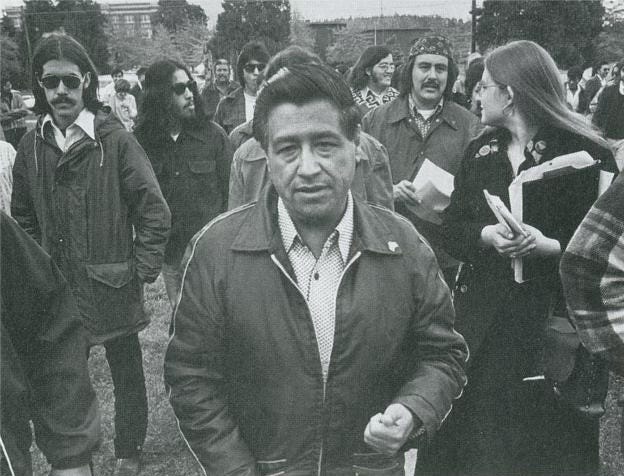
This week The New York Times published a devastating story about the great civil rights icon, Cesar Chavez (free link). In it, we learn in disturbing detail of Chavez’s crimes against girls and women, including sexual abuse and rape. For me, as for many others, this was a profoundly disturbing story, first for the great harm Chavez did to his victims and second for the ways in which in his crimes he betrayed his own political ethic.
According to his biographer, Miriam Pawel, Chavez kept in his office portraits of Gandhi and Martin Luther King as well as busts of John F. Kennedy and Abraham Lincoln. According to The New York Times, in that very same office he forced himself on a 13-year-old girl and told her not to tell anyone lest they get “jealous.”
Under the tyranny of the culture wars, these revelations are bound to get turned into another “both sides” story, as if there is little distance between Chavez and Jeffery Epstein. It is true, both were men who horribly abused girls. Both took advantage of their prestige and power to draw victims into their orbit. And both used their power to protect themselves. Morally speaking, I am not interested in trying to differentiate the crimes of Epstein from those of Chavez. Both equally deserve condemnation, even if the circumstances of the case were different.
But Chavez and Epstein were politically different, and here I don’t mean ideologically different, as if it were merely a matter of Left, Right, and Middle. Rather, their political differences concerned how they understood power itself.
Power is the unavoidable means of politics, which is another way of saying that power is unavoidable wherever two or more are gathered and have to figure something out. But power can be exercised in two radically different ways. One is through predation and domination, the other through argument and persuasion.
The core difference between these two modes of politics is centered on the relative balance of rational agency in the relationship between those involved. I am persuaded when I, by my own reason and of my own volition, come to act and believe in a certain way because I find another’s argument, appeal, or case compelling. But I am prey when power is exercised over me primarily in relation to my vulnerabilities. Persuasion respects my agency, predation denies it. (This critical distinction dates all the way back to Aristotle’s Rhetoric, not to mention the Ten Commandment’s prohibition against bearing false witness.)
Epstein was all predation—not just in his dealings with women and girls, but in his business dealings, his social life, and his patronage. President Trump comes out of the same world. A big part of the reason Trump attacked Iran was because he saw it (correctly) as weak and vulnerable. It is the same thing he did to the post-Bush Republican Party. And it is the same thing he’s done to more than a few women, and quite possibly young girls. For Trump, power is predation. (Faced now with the need to get allies to help with the crisis in the Strait of Hormuz, the president is finding himself persuasively helpless—predation has its limits.)
But Chavez was not all predation. He was a great persuader. He knew how to bring people along by respecting their rational agency rather than merely looking for their vulnerabilities. And it is this fact that makes his crimes all the more damning. His politics, apparently, stopped at the door to his office, at least when a vulnerable girl was present.
At least Trump’s politics are consistent.
Next week Civic Fields will be taking the week off for Spring Break recuperation.