

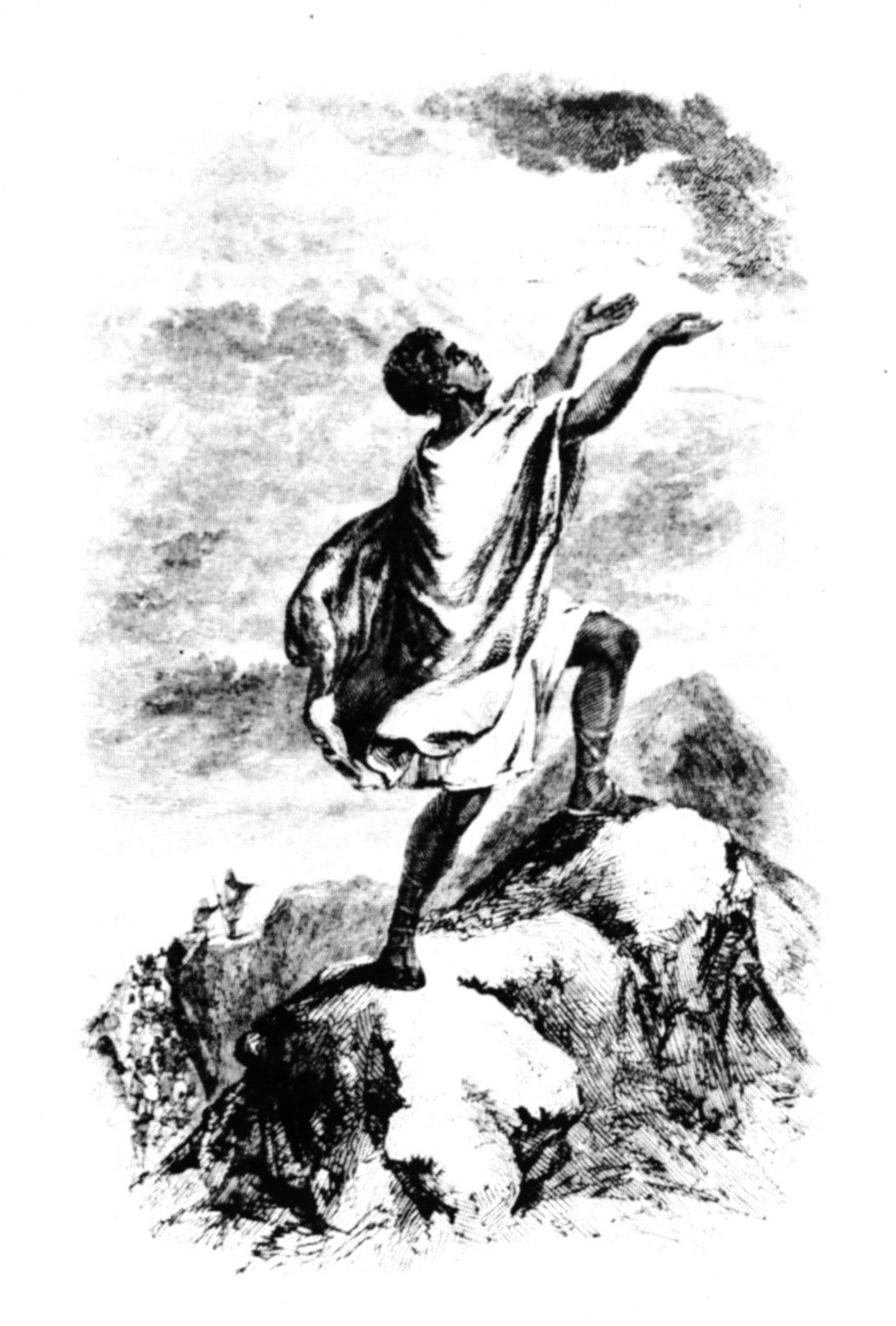
In 1829, David Walker, a North Carolina-born Black anti-slavery activist, published a pamphlet called An Appeal to the Coloured Citizens of the World. It was at once a severe critique of the slave-holding powers, an insistence on the equality of Black people, and a call to action. But it also contained a redefinition of citizenship.
Today the United States celebrates Juneteenth. The celebration marks the end of American chattel slavery, but it also marks an opening: the opening of full citizenship to Black Americans. That this opening has never been fully realized has caused some, with good reason, to grow pessimistic about the possibilities for Blacks in the United States. The questions of where and when and by what means Black Americans might, as a whole, be fully integrated into American political society remain.
Today, David Walker’s Appeal, though nearly 200 years old, still has much to teach us about the promise and perils of this fraught project. And the lessons center on citizenship.
Walker conferred the title citizens on his Black readers, all of his Black readers: Northern and Southern, Slave and Free, in the United States and elsewhere. From the get-go, therefore, he refused to let “citizen” be defined by the shifting legalities of the state. Citizenship is something he claimed for Blacks, irrespective of the law.
But as Melvin Rogers argues in his wonderful book The Darkened Light of Faith, the more consequential word in Walker’s Appeal was “appeal.” Recovering the political grammar of appealing reframes what Walker’s use of citizens was doing.
For Walker to “appeal” to his readers was to address them as beings capable of hearing, weighing, and answering claims. This was to implicitly enact a form of political standing for Walker and his readers that the legal order of his day categorically denied to most Blacks.
Walker did not petition the state for recognition; he called upon the judgment of his Black readers, and in doing so presupposed they had citizenly capacities that the dominant order insisted Black people lacked. (This included non-literate audiences, as Walker instructed readers of the Appeal to read it aloud to their friends and family.)
Historically, the liberal-democratic tradition has grounded citizenship as well as legitimate political speech in juridical standing—that is, the legal recognition of rights-bearing citizens—but this grounding has too often systematically excluded the racially dominated from democratic communication, registering their speech as noise rather than argument.
But there is an alternate concept of citizenship. We might call it “rhetorical citizenship”—not in the sense of “it’s just rhetorical,” but rather in the sense of a citizenship rooted in the capacity to appeal and be appealed to through speech. Rhetorical citizenship is rooted in the exercise of judgment rather than legal status. It is not an unbounded concept of citizenship, but its bounds tend to be more inclusive than the liberal-democratic legal paradigm has allowed.
It is bounded only by the answer to the question, Who among us have the capacities to participate in public discourse and political deliberation? It therefore offers a “path to citizenship” for even the dominated.
When legitimate political speech is conditioned on legal recognition, exclusion from citizenship becomes exclusion from political communication by definition. In the traditional liberal-democratic order, to speak politically you must be recognized as rational, yet recognition of “rationality” is itself contingent on a prior legal judgment about status. There is a quiet but vicious circularity to all of this. Racial domination exploits this circularity, denying Black people full political standing and then citing that denial as evidence of incapacity.
Walker’s Appeal breaks this circle by extending the rhetorical presupposition of rational capacity to those the dominant order refuses to count as having legitimate political standing.
Crucially, Walker in his Appeal did not argue for inclusion within the existing framework of legal citizenship, nor did he petition a sovereign. When he names his audience as the “Coloured Citizens of the World,” he does not describe a legal status Black Americans possessed. Rather, he names a political standing that the appeal itself calls into being. Walker treats the capacity for political judgment, not legal recognition, as the ground of political standing.
In The Darkened Light of Faith, Rogers identifies the operative principle here as what he calls demotic rationality—where “demotic” refers to “demos,” the Greek word for “the people.” It is “the people’s” rationality, not the state’s.
Demotic rationality entails the normative commitment that ordinary people, regardless of station, education, or race, are capable of rendering judgments about justice, freedom, and the common good.
Appeal is therefore bidirectional and horizontal: to appeal to another is to treat them as a being whose judgment matters and to present oneself as one whose claims deserve a hearing. As Rogers puts it, the horizontal standing of persons becomes the basis for vertical relationships of authority—political authority flows laterally between equals rather than downward from the state.
Lest this seem too anarchic, radical, or pollyanna, it is important to stress that Walker in his Appeal was but drawing on a widely recognized belief in his day of extra-legal citizenship: the Declaration of Independence, which Americans will also celebrate this summer, was itself an appeal to a “candid world” and assumed something like a world of citizen-judges capable of assessing the justice of their anti-colonial cause. That is, the Declaration of Independence was rooted in a rhetorical conception of citizenship, not a legal one. Rhetorical citizenship may be a radical tradition, but it is not an un-American one, let alone undemocratic.
In the struggle for justice, the capacity for judgment, not legal status, must be the ground for a common understanding of citizenship. The common world that you and I know and inhabit, as Hannah Arendt argues, exists only through a plurality of perspectives. Therefore, excluding the racially dominated is not merely a rights violation but an impoverishment of democratic reality itself.
And yet there are costs here. Where Rogers, through David Walker, recovers the emancipatory promise of appeal, it is also true that to appeal is to expose oneself: to make a public claim is to await a response that may never come or that may turn violent.
Walker’s pamphlet was banned across Southern states, its distributors arrested, and Walker himself died suddenly under suspicious circumstances in 1830.
On this Juneteenth, how many people are there in the United States, regardless of their status or color, who are making appeals but being ignored or repressed?
“Appeal” is thus an act of trust extended where it is not always warranted, demanding sacrifice—the claimant forsakes safety and deference, and the recipient surrenders the comfort of unchallenged privilege.
“Appeal” is not a costless free-for-all alternative to legal citizenship, but its deepest and most demanding expression: a practice that calls on its participants to recognize, renew, and risk a shared commitment to equality and judgment in a plural world.
–
Joseph Ofori Acheampong is a PhD candidate in the Department of Political Science at the University of Illinois, Urbana-Champaign.
