

Civic Fields has been mostly dormant this summer, but I have not. It’s been a big summer. Graham, my oldest (now 25) and managing editor here at Civic Fields, got married to a wonderful young woman in a wedding that felt festive and true. Linda and I traveled out west (Oregon), then up north (Michigan), and then out east (Virginia). I got lots of good writing, research, and thinking done on my intolerably Big Book covering the history of liberalism. And I spent lots and lots of time on my bicycle, including re-engaging in the primary vocation of my youth, bicycle racing. I did my first race in 33 years this May. It hurt like hell . . . and was great, great fun!
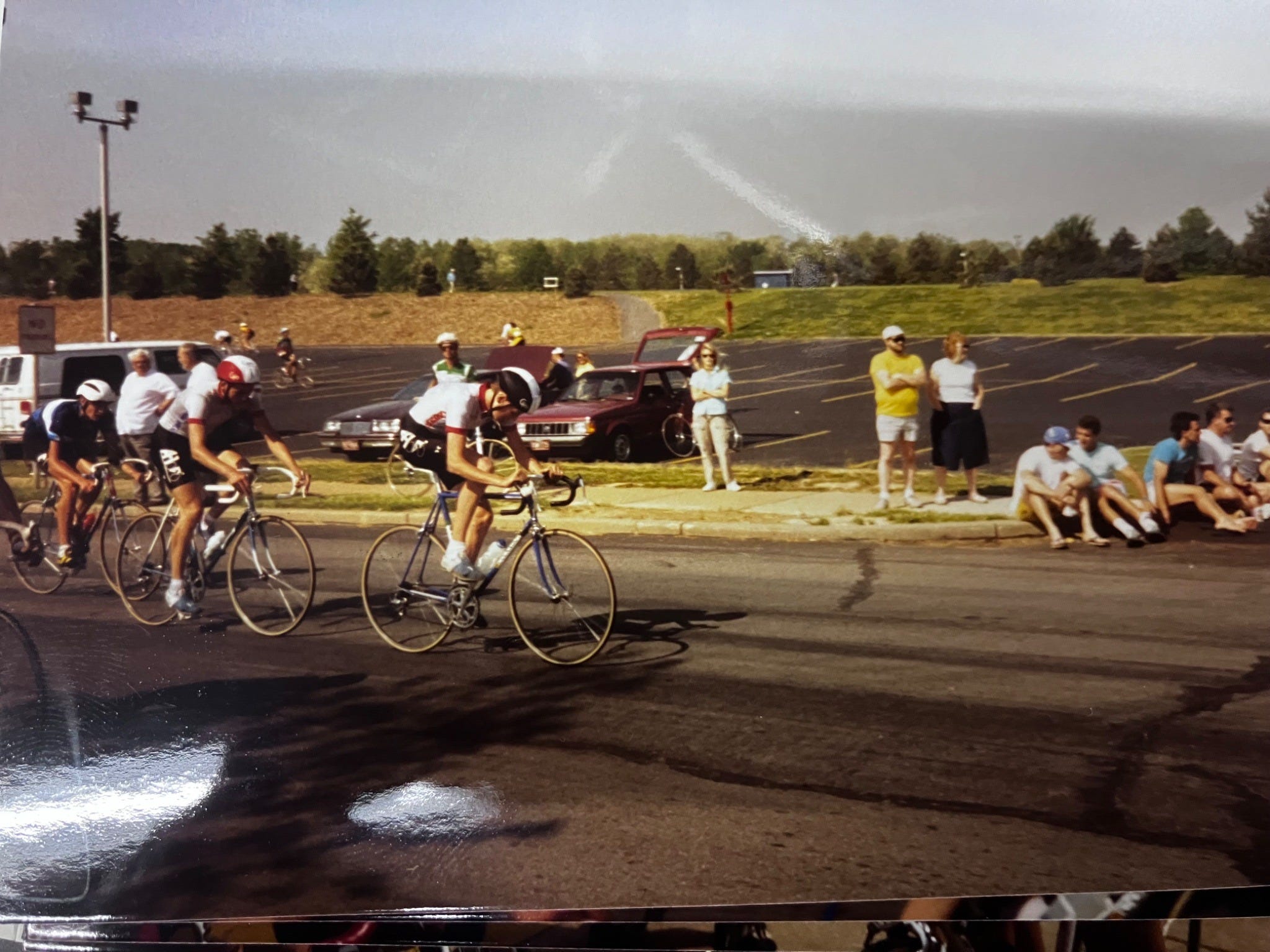
My summer cycling adventures helped me see something quite hopeful about the state of the nation. I want to take a moment here with you to reflect on my changing perspective.
A brief backstory: When I was 16, I won the state road-racing championship in cycling. When I was 17, I was competing for a spot on the Junior World Championship Team. When I was 18, I was invited to the Olympic Training Center as a cyclist. When I was 22, I quit cycling and moved on. There were clearly better cyclists in the world. An old teammate of mine went on to be one of them, competing in the Tour de France six times. I was good, but not that good.
This past year I started to take up the bicycle again with some gusto. A lot of 2026 has been about me coming to terms with just how formative those cycling years were for me. My non-cycling friends have long kidded with me about how I have an “edge” and “intensity.” Being back on the bike and doing some hard training and racing has helped me understand where that comes from. You kind of have to have an edge and be intense when zooming down the road with a bunch of others in a desperate and painful push to the finish. So getting back into cycling has been a way of reconnecting with parts of me that don’t always play well in other contexts. I’ve enjoyed that.
But getting back in has also come with big surprises. The bicycle-racing world has changed dramatically since I raced 30 years ago. And this is where my summertime shift in perspective comes into play and the seeds of some new hopes regarding our common civic life.
When I returned to cycling, three big things faced me like a trio of boulders rushing down a mountain: decline, decline, decline.
First, road racing—that is, point-to-point or lap-by-lap races on paved roads at high speeds and for long distances (think Tour de France)—is all but dead in the United States. It is hard to find road races. People are doing off-road or gravel races instead, or ultra-endurance races, or competitive group rides with no real racing at all. The near death of road racing really shocked me, as road racing was my passion and speciality as a young rider.
Second, the official sanctioning body of bicycle racing in the United States—USA Cycling—is a fraction of the player in the cycling world that it was back when I was racing. Back then, USA Cycling (called then by a different name) was your ticket into bicycle racing. To race at all, you had to have a license from them. You were rated on your license as a rider, giving you certain privileges the higher your rating.
The large network of road races back then was all officially run by USA Cycling: real race officials, a real rule book, and strict parameters around who could race and in what kind of race. USA Cycling was a system—indeed, an institution.
Today, while USA Cycling races still exist, most races are unsanctioned, off the official grid. There are no real race officials. The only rule book is the one the race organizers make up on the fly.
If racing in my younger days felt a bit like an Eastern-European cycling mill that eats up all but the very best, today it feels like the wild west. Sound familiar? Think of government. Think of houses of worship. Think of youth sports.
Third, I was shocked by just how much cycling has been metricized and gamified. Metrics are everywhere. People are competing “online” with anonymous others by uploading their data to some app and comparing. People even do “virtual” races. Riders talk about watts and measured heart-rate zones nonstop. While real road racing is harder to find, virtuality is everywhere in the cycling world.
Upon seeing all these changes, my first reaction was to lament what had happened to American competitive cycling.
There is a dynamism to road racing that is unmatched in the sport. Its drastic decline over the last twenty years is something I mourn.
The growing irrelevance of the official organization USA Cycling means that the sport feels far less structured and safe to me today.
And I have a hard time with “virtual” anything—I prefer the Real.
And yet throughout this summer my perspective has started to shift a bit toward seeing the virtues of what’s going on in American competitive cycling.
And I hope it is obvious that I am using bicycle racing here as a stand-in for larger social changes over the last twenty years.
One way to think about the changes to the sport is to see it as I first did upon reentry, as a story of decline. And there is great truth to this. Many things that I once valued in the sport are hard to find.
“Decadence” is indeed an appropriate term to describe a dominant characteristic of our age. We live in an age of decline in so many social institutions: social safety nets; congregational worship; dating, marriage, and romance; cinema; quality-built machines; working-class civic institutions, and government competency. Cycling is just one of many examples.
Here I have a “conservative” soul—in as much as I care very much about what is being lost. I regularly feel grief at what is happening in our society.
And yet, something else must be going on at the very same time. It can’t all be about decline.
This is what I’ve started to attend to as I have jumped back on the bike with fellow competitors this summer.
Cycling today does indeed have a “wild west” feel to it. Things feel a bit broken. But there’s also a lot of grass-roots energy, ingenuity, and interest in the sport. Things feel a bit broken, but things are happening—ground-up things.
Official, sanctioned, and “licensed” bicycle racing is pretty much in the dumps, but improvised, local, and community-based bicycle races of various kinds (and of various quality) are happening quite frequently. People are actively looking for ways to make cycling fun and competitive, even without the official trappings of USA Cycling. Yes, people are online racing “virtual” opponents, but they are also connecting with other cyclists in other parts of the country (even the world), learning through data about their own health and fitness, and participating at a pretty good clip in club and group rides. And the bikes themselves, well, they are just way better than they used to be (and way more expensive!).
Perspective is a matter of narrative—the stories we tell each other about what we see and experience.
The political Right points to decline as a reason to head to the culture-war trenches. Theirs is a militant and apocalyptic story of decadence centered on a lost golden age. Trump has turned this story into the fuel for the biggest con-job in the history of the country.
Spiritually, intellectually, and politically I have had to actively resist the vortex of nostalgia. It does no real good. For me to sit here and only say of cycling—or higher education, the church, or cinema, or politics, or other social institutions—“Geez, things were sure better back then!,” would be for me to put on what the rhetorical theorist Kenneth Burke called a terministic screen. Like fog on a mountaintop, the term “decline” can screen out the grandeur and dynamism around.
For on the flip-side of the breakdown of social institutions today—USA Cycling is just a small example—is a vibrant culture of cooperation and hustle. People today are working to make things work, make things work again, or make new things work.
I think this is happening in all kinds of ways in the United States right now. Applications for new businesses, for example, are shooting up and “start-ups” are not limited to businesses. There are community organizations, faith groups, small educational initiatives, arts efforts, gaming groups, record stores, and kickball leagues.
The Left is also prone to interpret social decadence only negatively. For them, it becomes a story of theft and destitution. People, they say, are being robbed. Safety nets have been stripped away. Workers are being forced into gigging, making ends meet, hustling. They should not have to suffer so. They have lost their democratic birthright.
The Left also has its nostalgic golden age.
I think it is possible, by contrast, to sharply criticize the state of the economy for working people and cry out against the corruption and neglect of politicians while still celebrating the energy, ingenuity, and hard work of ordinary folk.
Even as our economy and society are being dominated by a small elite tech regime, there is an energy from below that we need to pay close attention to, try to understand, appreciate, cultivate, and talk up. The Left, I am saying, would do well to start telling stories about ordinary people who are in fact making America great again in small ways. They should campaign on this. There would be nothing disingenuous about it. They should own the narrative not just of resistance but also of uplift. That’s what the most effective campaigns from the Left have done throughout American history.
Speaking of uplift, in 2020 Robert Putnam, a patron-spirit of Civic Fields, published a book called The Upswing with Shaylyn Romney Garrett. The book is centered on a data-driven story about how the United States became such a dynamic country in the middle of the 20th century. Putnam argued that the country learned how to become a “we”—as opposed to “me”—society. It did this through local organizations and various civic initiatives.
The latter part of the book then looked at the decline of the United States into a “me” society, especially in the 1980s and 90s. The book could be read as a downer, but the gist of “Upswing” was optimistic: because the United States once built a “we” society from the ground up, it can do so again.
There are no real sociological laws. Society, unlike the Earth, does not have natural gravitational forces. What goes up in history need not always come down, or vice versa. But I don’t think Putnam was making an argument for sociological laws that bode well for an upswing toward a new age of “we.”
Rather, the book suggests that grass-roots organizing, economic entrepreneurship, civic initiatives, and other ground-up efforts in the middle decades of the 20th century were a product of necessity as much as choice. When faced with a Darwin-esque social landscape, 20th-century Americans did not in fact resort to a war of everyone against everyone. They got busy building things, common things, real things.
My sense is that we are in the early stages of something like this right now. Cycling is an example.
This weekend I am going to do a bicycle race that is unsanctioned, unofficial, and grass-roots. There are things about it that make me nervous. I wonder about the safety of the roads, and even more of the skill of the other riders. Such things would have been carefully policed back when I was pushing hard up hills as a licensed young racer. But this weekend I am going to lean into the dicey roads and hairy riders, for this is unquestionably where the social dynamism of cycling can now be found.