

“We know, or should know, that every decrease in power is an open invitation to violence.”
-Hannah Arendt, On Violence (1969)
Saturday’s foiled attempt on the life of Donald Trump and other members of his administration barely got 48 hours of news coverage before being bumped off-screen by the visit of King Charles. Ho hum, it seems. Mass murder, even if foiled, is far less notable than courtly drama. On April 19, a man killed seven of his own kids and one of their cousins in Louisiana. The news of this atrocity barely broke into the headlines.
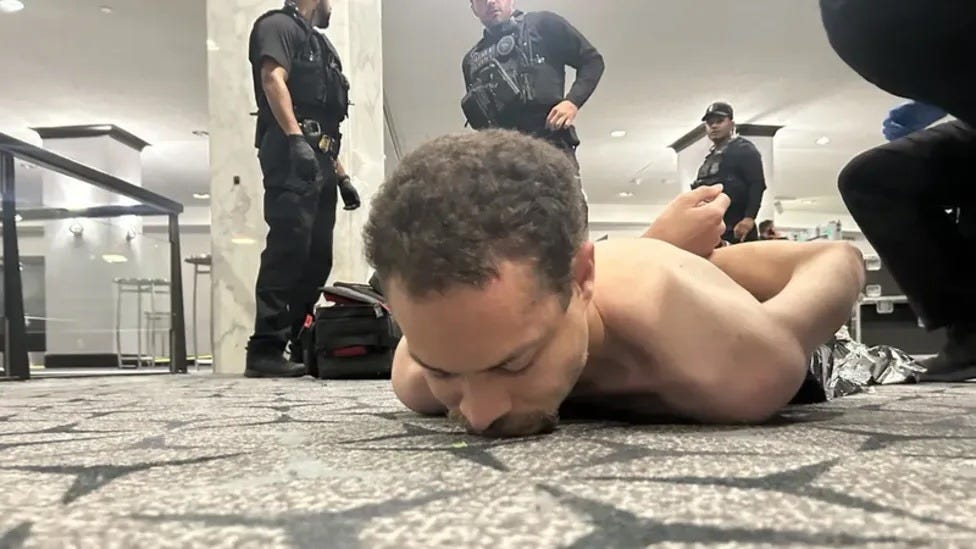
It is true, violence, be it domestic or political, is hardly new to the United States. It’s as old as slavery and the Revolution. But it seems somehow less and less suited for sustained public attention, let alone sustained public thought. According to the database Armed Conflict Location & Event Data, there have been around 1,000 instances of political violence in the United States since 2020. How many can we name?
I have begun to write about violence for Civic Fields probably five or six times since we launched. Each time, however, I have gotten bumped off course and filed the post away.
Sustained public thought about violence is in short supply because it turns out that writing and thinking about violence—particularly political violence—is quite difficult. It is not that violence is mute. It can be quite loud. It’s that it has so little that is truly meaningful or interesting to say. Violence is a blunt instrument. What else is there to say? It’s “senseless,” as we say (over and over again).
Recently, The Point magazine devoted a whole issue to the topic. The Point is at the very pinnacle of essayistic journalism and commentary in the United States. If any group of writers can be found that can find something meaningful and interesting to say about violence, it would be those at The Point. Yet, in their series of beautifully written essays, I found myself presented with what still felt like a lot of truisms: violence perpetuates violence, political violence rarely works the way its perpetrators intend, war is hell, religion fosters violence as easily as it checks it, and so on.
To this day, the best reflection on violence I have read remains Hannah Arendt’s On Violence. The book—quite manageable in size—was written in the late 1960s amid another era of rampant political violence: destructive street protests, political assassinations, overseas wars, and an accelerated nuclear arms race. On Violence was Arendt’s attempt to launch a frontal attack on the glorification of violence, particularly by people in government in the Johnson and Nixon administrations. But it was also an attempt to understand the popular attachment to violence, especially political violence, among folks on the Right, Left, and In Between.
Arendt did not write the book as a pacifist. Hers was not a criticism of violence as such, in each and every case. At least that was not her aim. Rather, in her typical Socratic fashion, the book was aimed at thinking through what exactly violence is, why people engage in it, and what it might be good for, if anything at all.
She was renowned for a penchant for making distinctions, and she was far better at the art of conceptual discrimination than almost everybody on the planet. “Authoritarianism” in Arendt should not be confused with “totalitarianism;” “work” is not identical to “labor;” “imperialism” should not be confused with “empire;” and, as she argued in On Violence, “violence” is not “power.”
We are accustomed—perhaps even conditioned?—to think of violence as a form of power, power in the extreme. Indeed, a whole intellectual tradition has existed since the age of ancient Athens that insists that the most effective means of wielding power is using, or threatening to use, violence. “All politics is a struggle for power; the ultimate kind of power is violence,” wrote the sociologist C. Wright Mills, who echoed the sociologist Max Weber, who echoed the philosopher Thomas Hobbes, who echoed John Calvin, who quoted St. Paul, “They do not bear the sword in vain, says Paul, for they are ministers of God to execute his wrath” (Calvin, Institutes, 1536 edition).
It is true, Arendt argued, governors typically bear the sword and use it to enforce their will. But the power of government, she argued, is not found in the blunt instruments of violence. For political power, she argued, is not reducible to a tool or instrument. Power is not something we “wield.” Rather, power is something we are given.
In On Violence, Arendt writes the following about power:
Power corresponds to the human ability not just to act but to act in concert. Power is never the property of an individual; it belongs to a group and remains in existence only so long as the group keeps together. When we say of somebody that he is “in power” we actually refer to his being empowered by a certain number of people to act in their name. The moment the group . . . disappears, “his power” also vanishes.
Therefore, Arendt argued, even the tyrant depends on “helpers” to wield what power he has.
Power is the essential ingredient of all political institutions, no matter their form. As she wrote,
All political institutions are manifestations and materializations of power; they petrify and decay as soon as the living power of the people ceases to uphold them. This is what Madison meant when he said “all governments rest on opinion,” a word no less true for the various forms of monarchy than for democracies.
Power is therefore complex. It is not the attribute of the One, but of the Many. It depends on a minimal level of coordination among a group of people and, as Arendt said, if that coordination breaks down, so does power.
Right now, for example, we are witnessing the slow erosion of the power of Donald Trump. It is not that he has lost his “charisma”—or his mind. It’s that he’s losing the trust and confidence of many of the people who previously supported him.
Violence, by contrast, can be done by any individual with the right tool or tools. And this fact, Arendt argues, is why we should pay attention to it.
In a political society, she argued, individuals are more likely to take to violence when they are feeling more powerless. I am not going to diagnose the psychology of Cole Thomas Allen, the man who’s been charged with attempted assassination and other crimes after Saturday’s incident. Based on his reported manifesto, however, I am willing to venture that he was not a man who felt particularly politically powerful. And indeed—again, psychological analysis aside—Trump’s recent frenzy for foreign wars is correlated with a notable drop in his approval rating and the fragmentation of his base.
Contrary to common opinion, people who are authentically empowered will be less, not more, likely to resort to violence.
I am going to follow up next week with some more data-driven reflections on violence. Here I will end with what may be Arendt’s most incisive claim about violence:
To sum up: politically speaking, it is insufficient to say that power and violence are not the same. Power and violence are opposites; where the one rules absolutely, the other is absent. Violence appears where power is in jeopardy, but left to its own course it ends in power’s disappearance. This implies that it is not correct to think of the opposite of violence as nonviolence; to speak of nonviolent power is actually redundant.