

Civic Fields is committed this fall to thinking about the potentiality of place as sites of civic sustenance and renewal. That’s what Matt Pitchford’s recent posts on Boston have been moving toward and, before that, my thoughts on the Vegasification of U.S. life. We will come back to these themes. This week, however, it seemed appropriate for me to write about the Charlie Kirk murder and its aftermath. Thanks for reading! - Ned
On September 10, Charlie Kirk was murdered in broad daylight in a horrendous act of political violence. As awful as all this was, the torrent of reaction since the murder says as much about the political significance of this event as any message written on an assassin’s bullet. People have asked me what I think about it. I have to ask, what part of “it” are we talking about?
What was the murder of Charlie Kirk? I ask “what was?” rather than “who is responsible?” or “what happened?” or “what will happen?” because the murder of Charlie Kirk was more than just one thing. Reckoning with it means reckoning with all its dimensions.
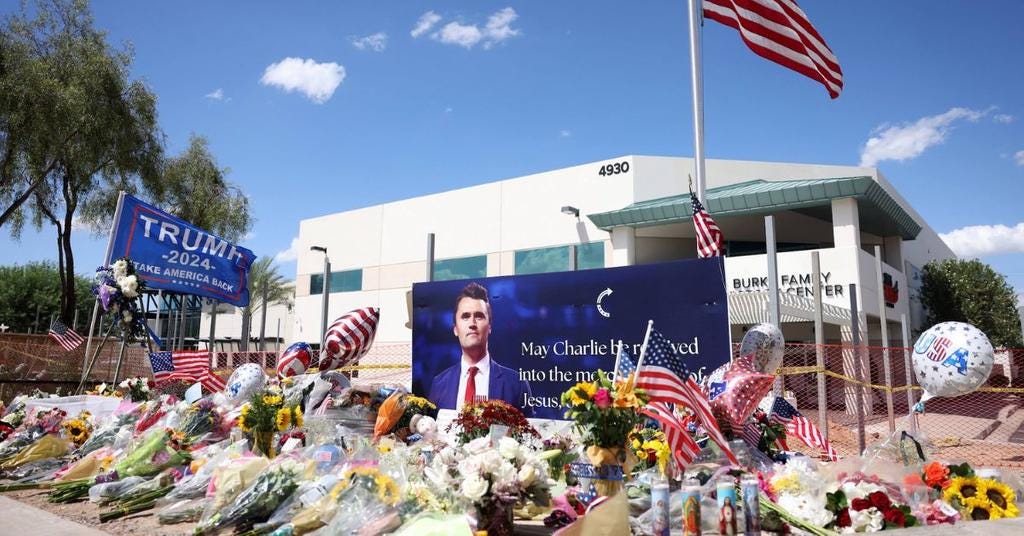
It was a murder. Plain and simple. Within 48 hours, the apparent shooter was found and arrested. Justice, presumably, will be done.
But it was also a political assassination. Whatever the mental state of the shooter, whatever political ideologies or (more likely) “vibes” motivated it, like the murder of Minnesota lawmaker Melissa Hortman and her husband on June 14, it was in some way, shape, or form politically motivated—or, better, motivated by the political climate in which we live.
That political climate is violent. The murder of Kirk is part of an epidemic of political violence that simply was not there during my childhood and young adulthood. It’s hard to say when exactly it began. Barack Obama’s first term as president seems a good place to look. A signature moment then was the 2011 mass shooting in Tucson, when nineteen people were shot at a constituent meeting being held by U.S. Representative Gabby Giffords. Six died, and others, including Giffords, were severely injured. The list of political acts of violence since 2011 is too long to recount here, but the January 6, 2021 attacks on the Capitol took political violence to a new level. Assassinations of political figures and mass violence are, tragically, too common parts of American history. Attacks on the Capitol by the nation’s own citizens had no precedent.
The January 6 violence, like the murder of Kirk, was instantly displayed on social media, soon followed by cable news and other outlets. I do not know the thoughts or intentions of Kirk’s murderer, but it surely could not have escaped him that his gruesome act would be broadcast and replayed over and over again on small screens. Just as the terrorist attacks of 9/11 were made for television, the culture of political violence in America today is often constructed for the small screen. In addition to being an act of political violence, Charlie Kirk’s murder was therefore also a massive social media event, and continues to be.
This is what I mean by asking “What was the murder of Charlie Kirk?” It was a murder, it was a political act of violence, it was part of a culture of political violence, and it was, and is, a massive social media event.
So when people ask me what I think about it, I have to ask what part of “it” they are talking about?
But there is one other thing the murder of Charlie Kirk was and is for millions of Americans.
It was for many an apocalyptic religious event.
Within minutes of Kirk’s shooting, a religiously infused Right-leaning social media network was lighting up with images of an older white man dressed in unconventional clothing, falsely accusing him of being a “trans” assassin. Others cried out against the “demonic” Left and posted of “spiritual warfare.” And yet others called for literal war in the name of saving the nation for God.
Here, the term “Religious Right” is just not enough.
There is no longer a “Religious Right,” if we mean by that one of several different stakeholders in a broader conservative political project. This was the Religious Right of the George W. Bush years. Centered on pro-life and anti-gay politics, the Religious Right then carried the moral banner for the Republican Party, acting often in cooperation with, but sometimes at odds with, free-market advocates, libertarians, neoconservatives, and traditional small-government conservatives. Today, however, it is factually wrong to speak of a “Religious Right” in this way.
The entirety of the Republican Party has been drawn into a quasi-religious orbit that is no longer centered on building a moral majority but on a “spiritual” call to arms.
But here the current term “Christian Nationalism” is not quite enough either.
There have been a slew of books written over the last decade about Christian Nationalism (for a very good overview, see here). Most of them focus on the conflation of Christianity with America, looking at how the Right has come to hold as a matter of orthodoxy that the United States was founded as a “Christian Nation,” etc. Some, thankfully, also focus on how there is a ton of money to be made in propagating these ideas: Christian Nationalists, they argue, are victims of their own consumption. Others look at the authoritarian tendencies within traditional patriarchal religion. And yet others look at the role race and racism have played in the formation of contemporary Christian Nationalism.
These are all helpful in terms of insight and understanding. They do not, however, quite get at what are witnessing right now.
Witness the dominant cultural narrative emerging around the Kirk murder. More than a murder, more than a political act of violence, more than part of an epidemic of political violence, and more than a viral social media event, Charlie Kirk’s murder is being presented as a battle cry from the throne of God himself, an event that marks the beginning of a new era of holy warfare in and for America.
Who is this warfare against? Liberals, the Left, socialists, radicals among the LGBTQ+ community, inheritors of the “gay agenda,” Woke America, etc. This hodgepodge of groups is sometimes presented in Right-wing circles as a well-coordinated ideological machine operating in the shadows of our educational and cultural institutions and hellbent on destroying America.
But now they are also regularly being framed as the manifestation of dark and demonic forces at war with Christianity and American freedom.
What is this?
I’d venture “Christian Nationalist Apocalypticism,” with an emphasis on apocalypticism.
Or, even more precisely, for reasons that will be more apparent, Nationalist Apocalypticism in “Jesus” dress.
What was the murder of Charlie Kirk in the frame of Nationalist Apocalypticism? A hinge point in an epic battle between dark and light. As my son Will sagely said to me recently, it seems like the Star Wars story read into a flag-draped Bible. In terms of a much longer history of ideas, it represents the resurgence of Manicheanism (albeit significantly simplified).
Standing outside of this worldview as I do, it is quite tempting to reinforce the battlelines by declaring people who believe this as fanatical. But I know some of these people. They are not fanatics, at least not most of them. They are family members, friends, co-workers, and neighbors. And listening to them, apart from all the online bravado, what you hear is fear. These are worried and anxious people.
The world around them, they fear, is changing so rapidly that they are in danger of losing all that they care about: country, faith, family, livelihood, and freedoms. They are, in general, too kind to go straight after the Left-leaning neighbor next door, and, as they already believe in a spiritual world, they defer instead to a more general spiritual explanation for the disorder around them: spiritual warfare.
Or spiritual warfare with an apocalyptic thrust.
Fed by social media, pastors, news sites, and books and magazines, they have a story to tell. It says that the very existence of their homeland and culture is under attack. It can be saved, but only narrowly, for the forces of darkness are great. Who will save America? Godly patriots, strong and bold men draped in the flag and flanked by “prayer warriors,” “men of faith” like Charlie Kirk.
We can argue about the Christian founding of the country, we can fight in the courts and the voting booth over abortion, and we can even have political enemies, but apocalypticism renders ordinary politics mute.
So, there is a democratic objection to be made to apocalypticism. It simply undermines the possibility of the democratic project by removing the nation’s conflicts from the realm of discourse and debate to that of the forces of Good and Evil.
But a theological objection is desperately needed too.
Indeed, I’ve been thinking about this for quite a long time, and I think theology is the best way to tackle apocalypticism. “Democracy” as a value may be too weak in the face of what people perceive as existential threats to faith and country.
But there is another problem with critiquing apocalypticism from a secular democratic perspective: secularism itself is deeply apocalyptical.
“Apocalypse” comes from a Greek word meaning “to unveil” or “to disclose.” It is fundamentally about knowledge: in the apocalyptic mode, some profess to know not only what the future offers, but how present events are connected to the future in a sequence of happenings that will culminate in some final end, a last battle.
Apocalypticism is essentially about knowing the meaning of historical events.
There is a strongly apocalyptic strand to secular thought. Some small but telling examples: when Barack Obama was elected in 2008, religious and non-religious progressives started to proclaim the advent of a “post-racial society.” Today, climate science, even though it is built entirely upon mathematically based approaches to probability theory, is widely taken to be prophetic, scripting out the end of things before they arrive. Indeed, so much social science is rooted in a claim to be able to predict the future based on the interpretation of present or past facts. While good social scientists, like good climate scientists, show great humility about their predictions, secular thought itself remains deeply apocalyptic: it aims, in the name of progress, to chart out a progressive course for human history, and it does so on the basis of a claim to know.
Practically speaking, especially in the realm of technology, secular thought has gone further and sought to control history. Innovation, development, planning, design, engineering—these deeply modern enterprises are all oriented in one way or another toward techniques of control. Writ large, secular modernity is very much about the control of history. And it has put us in an “apocalyptic” condition. Michel Foucault, that great archeologist of modernity, writes:
For millennia man remained what he was for Aristotle: A living animal with the additional capacity for a political existence. Modern man is an animal whose politics places his existence as a living being in question.
Foucault was certainly thinking here of nuclear weapons, but we could add a number of other existential threats to human existence that are the product of modern technological, economic, and political systems: chemical weapons, bioweapons, the toxic destruction of the earth and its atmosphere, accidental virus leaks, AI, etc. The point here is that secularity, which is premised on a philosophical level on a wresting of control of human life from the gods and locating it in human ingenuity itself, is deeply apocalyptical.
Seen in this way, Christian-flavored Nationalist Apocalypticism represents a cultural attempt to wrest control back from secular modernity, reclaim it for “God,” and reinterpret the national destiny in terms that are equally epic but based on a form of knowing that is anti-modern: the interpretation of “signs.”
For example, the sign of the shooting of Charlie Kirk.
I know that a good many readers of Civic Fields do not claim any particular religious faith at all. I also know that a good many do. We are a pluralistic readership, and that’s a very good thing. But I want to urge the atheists, agnostics, and folks of other faith persuasions among us to take seriously the apocalyptic underpinnings of dominant approaches to history in U.S. culture, whether secular or religious in character, and to take seriously as well a theological response.
And as a Christian myself, I want to say that apocalypticism is not in fact Christian.
Here, I want to ask for not just the patience but the attention of non-religious readers as I briefly trace out why.
The Christian theological critique of apocalypticism runs two ways (neither of which is mine or any one person’s, for that matter, but part of a broad and longstanding theological tradition).
First, as the theologian and pastor Paul Axton has recently re-explored in the context of Christian Zionism, apocalypticism turns Christ into a failed prophet. The anxious fear that so many Christian Nationalists exhibit is rooted in a teaching that runs deep in American Christianity, associated particularly with what is known as “dispensationalism.” It implies that while Christ started something, he did not successfully complete it. Other historical events are needed to complete God’s victory, things like the rise of the modern nation of Israel, American wars in the Middle East, or even the invention of helicopters.
Thus, many people who identify as Christian live a profoundly anxious existence, looking directly or indirectly for “signs” in history, reliant on preachers and teachers to tell them what various events mean for the end of the nation and the world.
But, as Axton argues, if God needs Israel or America or helicopters, this means the historical Christ fell well short of achieving God’s purposes. Whatever your beliefs about this historical Christ, the idea that he fell short of the goal is quite at odds with the kerygma (proclamation) that is in the New Testament, where Christ is proclaimed as having finished the work of cosmic redemption, even as a mysterious unveiling (apokalupsis) of that completion yet awaits.
In light of this biblical kerygma, apocalypticism, with all of its anxious insistence that subsequent historical events are needed for God to prove victorious, looks altogether like another, extra-biblical religion that puts Christ in the back seat of history.
Second, as the theologian Charles Mathewes writes, apocalypticism, because it rests on a claim “to know,” turns faith into a form of forecasting. By contrast, Mathewes advises Christians,
God's will is not captive to our expectations. The lesson of providence is not that history can be finally solved, like a cryptogram, but that it must be endured, inhabited as a mystery which we cannot fully understand from the inside, but which we cannot escape of our own powers.
A big part of faith is not knowing, including not knowing the ultimate meaning of historical events, or even if they have such a meaning.
What would this sort of epistemic humility look like for comprehending Charlie Kirk’s murder?
Ultimately, I don’t know. It was clearly a murder, it was clearly connected in some way to politics, it is clearly part of an epidemic of political violence, and it is clearly being fit by the Right into a myth of martyrdom, but interpretively speaking, like everything else that happens in history, it is a “sign” we can puzzle over but cannot decisively solve or fit together beyond a limited, immanent frame.
It would, that is, look like faith rather than certainty.