

Last week, Civic Field’s looked at Hannah Arendt’s On Violence, in which Arendt not only distinguishes between “power” and “violence” but goes further to posit an inverse relationship between the two in the real world. She argues, in sum, that where political power increases in scope, violence in society is likely to diminish in scope. Or, inversely, where violence in society grows, political power is likely to be declining. Therefore, as she puts it in On Violence, “We know, or should know, that every decrease in [political] power is an open invitation to violence.”
I think this basic idea can be termed “Arendt’s Law,” for it not only has the form of a social-scientific law but also, in so many ways, encapsulates the essence of Arendt’s contribution to political thought.

I know there’s a cohort of political science wonks out there among the readers of Civic Fields. This post, I hope, will appeal to them and perhaps provoke some thinking, even research, on their part. I hope it will.
But even if you are not among their number, stick with me a bit. Near the end of this post, based on Arendt’s Law, I am going to venture a little forecasting or “prediction” about the coming years in American society.
To get there, however, I need to take some time here to do things:
(1) I need to explore the basic ideas behind Arendt’s Law a bit more.
(2) I need to test Arendt’s Law, admittedly very provisionally, against the data.
I need to do the former because the basic ideas behind Arendt’s Law are not immediately intuitive—they need some explanation. And I want to try Arendt’s Law out with some data to see if it has any real-world legs.
So, first, more on the basic ideas behind Arendt’s Law . . .
Arendt was a proponent of “power,” which she defined as “the human ability not just to act but to act in concert.” She was also an opponent of violence, which she conceived of as the use of force to do harm to others, typically with the aid of tools or technologies. Most importantly, Arendt believed that growing political power was the best antidote to violence in society. This is an essential idea in her political thought.
Putting the qualifier “political” before “power” was not something Arendt always did, but it is important for understanding what she was all about.
She recognized that “the human ability not just to act but to act in concert”—that is, power—could take on violent forms. But when it did, she argued, it was because those people acting in concert were acting as One. Collective violence, to use a theoretical term, is “univocal”—it has but one voice.
Let me explain.
Think of the slogan, “An Army of One,” used by the U.S. Army. It contains what, for Arendt, is an essential truth about collective violence: in order for collective violence to be effective, individuals must surrender their individuality to the collective.
This is one reason that she thought “collectivist” societies were prone to using violence to force an agenda or ideology. But it was not collectivism as such that bothered her, but Oneness. As we will see, she thought, via “republicanism,” that there is a way of doing collectivism without Oneness.
Arendt’s great book The Origins of Totalitarianism examines violence in Nazi Germany. Surprisingly, Hitler’s army was the least of her concerns. Rather, she focused on two other sources of violence in Nazi Germany: the mob and the masses. Mob violence entailed relatively small bands of official and unofficial vigilantes acting as One. These mobs, as she explored, were supported by the “masses,” who, also acting as One, accepted and went along with mob actions against Jews, gypsies, gays, and other Others. “The merely onlooking majority,” she later wrote in On Violence, “is in fact already the latent ally of the [mob] minority.”
In Eichmann in Jerusalem, she looked at another form of collective violence where a social entity acts as One: bureaucracy. The “power” of bureaucracy is its capacity to fold individual persons into an impersonal organization so as to act as One.
Collective societies, armies, mobs, masses, bureaucracies: all gravitate toward acting and speaking as One. They are structurally bent toward the “univocal.” They are therefore tempted to use violence to get their way, for effective violence, Arendt argued, is always the instrument of One (see her On Violence). Where violence becomes instead the tool of many different individuals acting independently, it loses its instrumental force and just becomes chaos.
The rise of various “individualist” political philosophies —libertarianism, classical liberalism, and now even forms of reactionary futurism—can be rooted in the same basic insight that “collectivism” generates social violence. Friedrich Hayek’s famous Road to Serfdom rested on just this anxiety.
But Arendt never jumped on the libertarian or individualist bandwagon. She was not even a “liberal” in the classical sense.
She thought individualist philosophies denied something basic about the human condition—what she called “plurality.” As she wrote in The Human Condition, “men, not Man, live on the earth and inhabit the world.” The problem with the “individualist” reaction to collectivism was that individualists, no less than collectivists, typically seek to act as One, making violence a temptation—as slogans like “Stand Your Ground,” “Don’t Tread on Me,” and “Keep Out” each suggest. Not surprisingly, individualist philosophies often take on a militant tone.
Arendt was not an individualist. Rather, she is best thought of as a “republican” in the classical sense (a more thorough discussion of her politics would need to qualify this a good bit, but in principle she was a republican).
In its older sense, republicanism represents the attempt to bring different people—a plurality—into a political and collective entity that can exercise power through the arts of speech and action.
Republicanism in this sense shares a great deal of ground with democracy in a small-“d” sense.
Arendt was a 20th-century democratic republican (again, with qualifications). For this reason, though a refugee from Germany and a disciple of the Marxist theorist Rosa Luxemburg, Arendt was quite invested in the ideals of the historic American democratic-republican project.
For her, democratic republicanism represented a means of ameliorating social violence.
It was from this basis that she offered what I am calling Arendt’s Law: the amount of genuine political power in any given society is negatively correlated with the ubiquity of violence in that society.
Is there any empirical basis for Arendt’s Law?
I am not a social scientist. Therefore, I am not the one to answer this question with any authority. However, I am familiar enough with social scientific methods to at least be able to combine two relevant data sets—the Armed Conflict Location Event Dataset (ACLED) and the Legatum Prosperity Index—and look for correlations. I offer this as a preliminary exercise, a provocation for my social scientific colleagues. I realize that the data sets, sample sizes, etc., all need to be further examined. I am not prepared to make claims about statistical significance in a technical sense. But this is simply a way of initially trying Arendt’s Law out on some real-world data.
What follows in italics are some of the nuts and bolts. If you are not interested in the details of the data analysis I did here, you can skip through the italicized part and jump to my “findings.”
With the help of Claude AI, I compared data from 138 countries from 2020, 2021, and 2023 in ACLED, which counts instances of political violence or internal violent conflict on a country-by-country basis, with data from the same countries and same years in the Legatum Prosperity Index, which uses 12 different social-wellbeing measures to rank “national prosperity.” Since the ACLED data does not use a per-capita measure, I converted it into one using World Bank population data before comparing it to the Legatum data. I used 2020, 2021, and 2023 because these were the only years I had sufficient data for all 138 countries to do the comparison.
The Legatum Prosperity Index measures ended up outlining the story I want to tell, so I want to list them here. Legatum’s measures are broken into three categories with four sub-indexes in each:
Economic Conditions:
Economic Quality
Investment Environment
Enterprise Conditions
Infrastructure & Market Access
Governing Conditions:
Governance
Safety & Security
Personal Freedom
Social Capital
Broad Environmental Conditions:
Living Conditions
Natural Environment
Health
Education
I wanted to know if scoring relatively high on any of these sub-indexes correlated with scoring relatively low on the amount of “violent conflict” per capita in the same country (per ACLED). So I ran the data in Claude.
Across the board, relatively high Legatum sub-index measures correlated positively with relatively low per-capita “violent conflict” measures across Legatum’s sub-indexes. So there is reason to believe there may be a statistically significant correlation between higher “national prosperity” and lower internal violent conflict. Even though I am being super cautious here about claiming statistical significance, this is common sense—no big surprises here.
Also, not a surprise: the strongest negative correlation was between “Safety and Security” in a country and minimal internal violent conflict (ρ = -0.645), but here, of course, we are caught in a tautological loop.
Things got a bit more interesting, however, in other details.
First, the weakest correlation was between measures of “Personal Freedom” and the amount of political violence in a country. In Legatum, the “Personal Freedom” sub-index measures the sense an average person has of basic rights, liberties, and social tolerance. It is a subjective measure, and it is one where a person could score low because they live in an authoritarian but “safe” country (i.e., Singapore), or score high even though they live in a very violent country but feel their personal freedoms are not severely restricted (i.e., Ukraine). This would explain the weaker correlation. But more meaningfully, just because you feel like you live in a country where rights are respected does not mean that you live in a country that is relatively non-violent. A culture of rights does not tell us much about a culture of violence. Or so it would seem.
The even more interesting correlations had to do with the four sub-indexes under Economic Conditions and with the first sub-index under Governing Conditions, namely “Governance,” which measures “whether there are checks on power and whether governments operate effectively and without corruption.” Excluding “Safety & Security,” these five measures showed the strongest negative correlation (exceeding ρ = -0.500) with internal violent conflict in a given country.
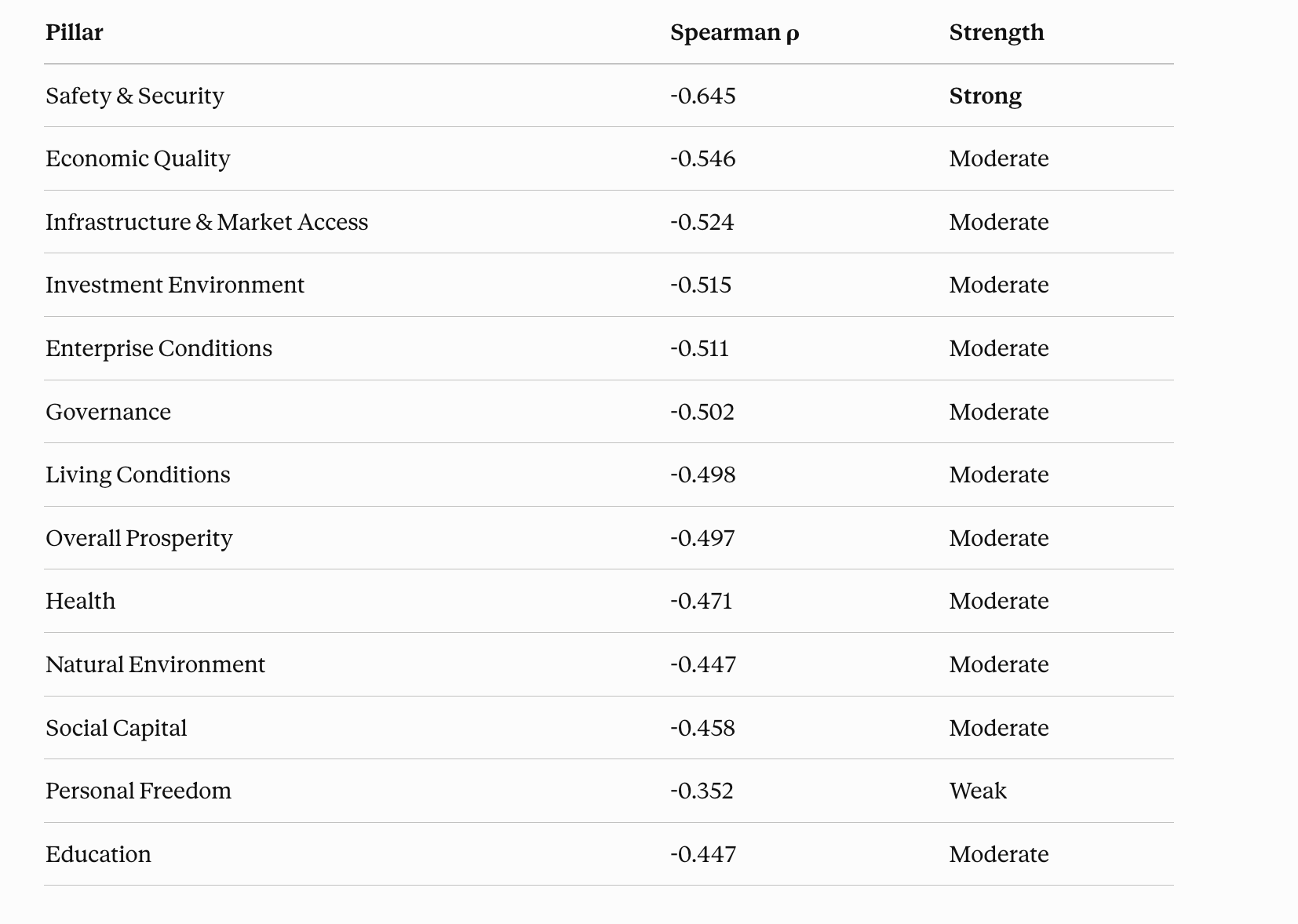
What this all means is that high scores on economic opportunity and integrity, together with non-corrupt and reliable governance, may predict low social violence.
What it also suggests is that, relatively speaking, the correlation is not as strong with some of Civic Field’s favorite themes: Social Capital, Personal Freedom, and Education.
What does this all say about the potential “validity” of Arendt’s Law?
It suggests—preliminarily, speculatively, provocatively, and imperfectly—that countries with good governance and relatively open, reliable, and trustworthy market opportunities are likely to have less internal violent conflict. Or, to put it another way, it suggests that countries where corruption is low are also quite likely to be countries where social and political violence is low.
This would suggest that countries with more internal violent conflict (even conflict coming to that country from other outside actors) are countries where there is a higher amount of corruption. Poorer governance and poorer market opportunities presumably are correlated with higher amounts of corruption, which seems to be related in some way to higher amounts of social and political violence.
Here, Arendt’s Law seems to apply, for corruption is precisely a means of steering around and indeed denying authentic political power in Arendt’s sense: rather than different people acting in concert on behalf of common concerns, corruption is about the few “making deals” outside of the public realm.
Not coincidentally—and here I can write with more authority—historically speaking, a central concern of political republicanism has been the problem of corruption. Corruption has been an explicit theme among (classical) republicans seeking to reform politics. Corruption in the 18th century was strongly associated with royalist, oligarchic, and other forms of courtly politics. Republicans hated courtly politics for a variety of reasons, but a big part of it was that it was so corrupt.
The republican solution to courtly corruption was to generate and organize political power from the ground up via the rule of law, checks on power, political representation, the franchise, and demands for public virtue.
Arendt’s Law certainly has a basis in this republican tradition. My social scientific adventure here suggests that it may also have bases in empirical data.
This little experiment may also represent a check on the hopes of Civic Fields. Inspired by Robert Putnam, Tocqueville, and others, this newsletter has been a huge champion of the “social capital” and “education” theses, which say a better connected and better educated society will also be a more peaceful and thriving society. But it seems there are reasons—in Arendt’s Law, in the historical “republican” project, and perhaps the testimony of contemporary social-scientific data—to suggest that our greatest concerns need to be combating corruption and building popular political power.
Until then, and more ominously, given the growing corruption among the regnant American kleptocracy, there are reasons to think that violent internal conflict in the United States will grow in the coming years.