

When one day historians begin to write about these fateful days in U.S. history, the curious ones will certainly want to look past the big headlines and understand why Vice President J.D. Vance, on the eve of failed peace talks with Iran, spent a couple of days in Eastern Europe in a last-ditch campaign effort to prop up an unpopular prime minister.
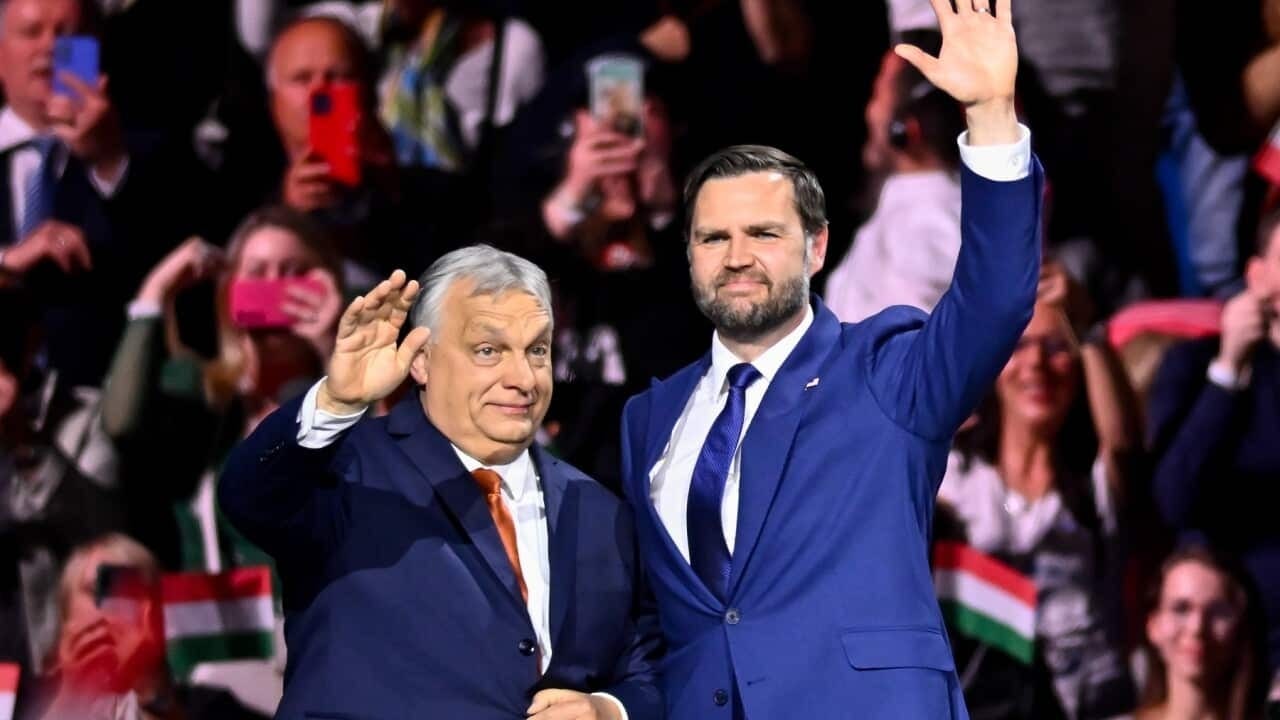
It did little good. On Sunday, Victor Orbán’s Fidesz Party was handily defeated at the polls by the center-right Tisza party, putting an end to Orbán’s sixteen-year reign as Prime Minister of Hungary.
The United States is in the middle of a self-inflicted global energy crisis spiraling out of control and in a war in danger of reigniting. Vance was tagged last week to lead the peace negotiations with Iran.
Why take a detour to Hungary on the way?
Answering this question is not as straightforward as it is often treated in outlets like The New York Times or The Atlantic. There, Victor Orbán has long been treated as a dangerous bellwether for the particular kind of populism that Trumpism wants to replicate. As things go in Hungary, so they (could) go in the United States. Indeed, earlier this week, the Times published an editorial saying that if we want to know how to defeat Trumpism at the polls, we should take our lesson from Orbán’s victorious opponent. I am seeing very similar arguments all over anti-Trump social media this week, as well as plenty of prophecy that Orbán’s defeat means that the years of populist authoritarianism are coming to an end.
But obviously, Hungary is not the United States, not even close. Where did we get the idea it was? It turns out to be J.D. Vance’s camp, National Conservatism.
There’s nothing wrong with being a small country like Hungary, but the United States is not among such countries and never has been. When measured by purchasing power (PPP), Hungary’s GDP per capita is $47,600, compared to $85,800 in the United States. Per the IMF, Hungary’s GDP per capita puts it 48th in the world, 42 spots behind the United States. Hungary’s economy is so small that it comprises just over 1% of the European Union’s output. It is mostly seen by the EU as a source of cheap manufacturing labor. Orbán rose to power sixteen years ago by railing against all of this and promising better days, but during his long reign, the country’s economic growth took a downward turn and fell behind other post-socialist European countries.
Amid all of this, Orbán’s rule has made Hungary a case study for scholars of democratic backsliding. After the Fidesz Party took power in 2010, as one scholar writes, Orbán “moved to radically curtail the power of the judiciary, obstruct the autonomy of civil society [including universities], change the election laws to their own advantage, and consolidate their control over both the state and private media.” Today, the Trump-allied Heritage Foundation puts Hungary near the bottom of European countries in its (quite hypocritical) “Index of Economic Freedom,” knocking it especially hard for a lack of “Government Integrity,” “Government Spending,” and “Fiscal Health.”
Nevertheless, for all of this, among all the nations in the world, Orbán’s Hungary has been the leading light of American National Conservatism, the single most powerful national example for the single most powerful movement in American federal governance today.
National Conservatism is at the heart of the current Trump administration, the central force behind Project 2025, ICE raids, attacks on American universities, and media outlets. National Conservatism pretends to be anti-globalist. In fact, it is just another form of globalism, one that puts individual sovereign national leaders like Trump, Orbán, Netanyahu, and Xi at the center of global dealings rather than international institutions like the IMF, United Nations, or European Union. National Conservatism wears “patriotism” and “nationalism” on its sleeve, but its “patriot” is not the patriot of any particular nation, but just the idea of a patriot. Its “nationalism” is not tied to any particular nation, but simply to the idea of the “sovereign nation” itself. For all the ways in which National Conservatives rage against the “placelessness” of the lives of cosmopolitan liberals and coastal elites, when not at their private estates, they themselves live almost entirely in the world of abstractions.
J.D. Vance is not the only National Conservative who grew to love the abstract idea of Orbán’s Hungary. Patrick Deneen, sometimes christened the intellectual vanguard of American National Conservatism (he very much looks the part), has made pilgrimages to Hungary. Gladden Pappin, an American political scientist who helped found the National Conservative journal American Affairs, is now the president of the Hungarian Institute of International Affairs. Tucker Carlson has ventured there. Rod Dreher, best-selling author and mercurial genie of the American National Conservative movement, packed up and moved to Hungary.
.jpg)
Meanwhile, National Conservative-aligned publications like First Things and National Review have regularly covered the country under Orbán’s rule with admiration. The American-based Conservative Political Action Conference (CPAC) expanded to Hungary, holding a major convention there last year under the banner “The Age of Patriots is Here!” Indeed, Trump, who in fact is not much of a National Conservative—or a National Anything for that matter—nevertheless seems to have reserved at least one of his hydra of roving eyes for the affairs of Orbán, sending his hook-up man Paolo Zampolli to Hungary last week to accompany Vance.
But, really, we must ask why Hungary, a struggling landlocked country in Eastern Europe, about the size of Indiana, with a population half the size of the New York metro area and an economy closer in real dollars per capita to that of Iraq than Indiana?
To be clear, Americans—especially American elites—have regularly looked to other countries as sources of inspiration. The Founding Fathers were particularly invested in ancient Rome, seeing it as a model of the promise and perils of republics. They also looked to the contemporaneous Dutch Republic. Jefferson was, for a time at least, quite preoccupied with what was transpiring in France amid the French Revolution. Meanwhile, in the run-up to and during the American Civil War, Greece became the object of enormous enthusiasm among Yankees. As Greece fought for independence against the Ottoman Empire in the 1820s, Americans lined up in support. Later, as Garry Wills has shown in his remarkable book, Lincoln’s famous Gettysburg Address sat against the backdrop of the American memory of the Greek democratic legacy. Later in the 19th century and well into the 20th century, many liberal American political elites shared a great admiration for the British Empire. And as recently as the 1980s, we can find American admirers of the ingenuity and work ethic of the Japanese.
Greece and Japan, like Hungary, were relatively small countries, but they obviously stood for great things: democracy and freedom-fighting in the case of Greece, and remarkable economic growth and high-quality manufacturing in the case of Japan.
But Hungary? What has it stood for under Victor Orbàn’s rule?
There are three somewhat glib answers—but true nevertheless—and three more complex ones.
Starting with the glib:
Orbán styled himself as a kind of patron for God, Family, and Country. American National Conservatives resonated, emphasizing as they do traditional religion, strong and growing families, and tight borders. Oddly, however, Hungary has not been a particularly religious country in actual practice during Orbán’s rule. Indeed, religious participation and identification consistently fell. Meanwhile, the population under the “pro-family” regime continued to decline, as people left the country for better lives. None of this matters to National Conservatives. The point here is that just as National Conservatives prefer abstractions, so they tend to care far more about symbols than substance. Orbán was a symbol. They love symbols.
Second, under Orbán, Hungary was a burr in the shoe of the European Union. The irony here, apparently lost on National Conservatives, is that this was a fact made possible only by the prior fact that Hungary was included in the EU in the first place. Precisely because the EU is not just a bunch of “faceless bureaucrats,” as Vance and National Conservatives like to say, but a political entity with a constitution and a parliament, Hungary, despite its meager size and economy, was able to use its vote to constantly pester its European neighbors. Hungary has therefore been the source of intense pleasure for American conservatives whose political palette is wetted only by sucking the bile out of liberals.
Third, Hungary’s declining population is relatively homogenous, with ethnic Hungarians comprising 84% of the country. Even amid the great influx of migrants and refugees from the Middle East and Africa to Europe, Hungary has managed to stay pretty White by enforcing strong border policies. In other words, Hungary looks nothing like America. It does look, however, a lot like your typical American CPAC Convention.
/https://static.texastribune.org/media/files/7db901cb81e225a596e161fd362ce171/0807%20Trump%20at%20CPAC%20JV%20TT%2001.jpg)
I have spent a good deal of time observing National Conservatives from afar, and I think these glib reasons match the character of many of those involved in the movement.
But these still are really quite meager reasons to hold another country up as a model for the United States, no?
So there are good reasons to look for more complex factors in play here.
For one, the Orbán-love tells us something about the nature of the social networks that are at the heart of Western reactionary conservatism today. Social networks in a global age are paradoxical. They can be incredibly large in reach, connecting with millions upon millions of people, and yet, power in the global social network is never distributed evenly across its reach. Not even close. Rather, global social networks are organized according to hierarchies, and money tends to be the currency that determines who is at what level. And the higher up you are, the smaller the circle. The National Conservatives, by and large, lack good sense, but they don’t lack deep pockets or international networks. Orbán and American conservatives are linked by very small but overlapping networks of global influence, power, and money. They comprise a clique.
But an equally powerful currency in all of this is attention, and Orbán, like Trump, knew (until recently, it seems) how to master attention. In the digital-based attention economy in which we live, small can be better, for attention in digital media is achieved by standing out from the “crowd,” so to speak. Being a minority or being extreme is a strategic advantage. Trump is a master of attention because he is such an extreme outlier morally (where he is an extraordinarily small man, one of the smallest in world history), even as his policies, save immigration, have been quite conventional within the post-Reagan Republican Party.
National Conservatism, unlike Reaganism, is organized to maximize attention rather than to maximize votes. It is not a majoritarian political movement, nor does it have any real aim to be. Rather, it aims to exploit the power of small numbers to attract outsized attention in our media landscape and to build out of this the political power of a ruling minority on the vibes of a distracted public that simply has too many other things to pay attention to other than political policy and personal character. As a rabble-rousing populist figure who delighted in sticking it to European liberals but never built an authentic and sustainable political majority in his own country, Orbán got the attention of American conservatives because he showed them just how small can go big.
Indeed, ultimately, National Conservatism’s Orbán-love tells us just how small these men themselves are (yes, overwhelmingly men). Their networks are not only organized around small cliques of financial and attention elites, but they actively work to shrink the nation down to their own petty size. For all their talk of “national greatness,” the American National Conservatives are proving that it is just talk. For reasons that seem to be more psychological than political, they seem to need their “great leaders” to be men of utterly minimal character—Orbán, like Trump, used his office to enrich himself and his family. He was voted out of office last week because his rampant corruption was just becoming too much to hide.
Why are National Conservatives drawn to such small men? The political descendants of the Lilliputians, they can make themselves “great” only by shrinking the nation down to size—Victor Orbán’s size, or Donald Trump’s size.
“There is a time in every man’s education when he arrives at the conviction that envy is ignorance; that imitation is suicide,” wrote Ralph Waldo Emerson in “Self-Reliance.” That point, it seems, has not yet been reached in the education of America’s National Conservatives. They are on a suicidal course and don’t mind taking us with them.
It’s true, Orbán’s Hungary seems to be over. But U.S. National Conservatism is not—not yet, and maybe not even close to being yet. Despite what The New York Times says, what happens in Hungary is not a reliable indicator of what’s to happen in the United States, or even of what we should do. For sure, there are lessons we can learn from post-Soviet Europe, but the future of American electoral politics is not among them. Trump and the National Conservative regime that supports him are distinctly American phenomena enabled by distinctly American ways of doing politics. Their presence is our disease, not Hungary’s.
Rather, we need to own up to our own country.
Recently, at the Supreme Court’s hearings on “birthright citizenship” —a Constitutional principle to which National Conservatives are generally opposed—the Trump administration’s solicitor general again summoned the parochial vision of the movement by arguing to the justices that America should just be like other countries:
[T]he United States’ rule of nearly unrestricted birthright citizenship is an outlier among modern nations. It’s a very small minority of nations that have that rule. For example, every . . . nation in Europe has a different rule [than the United States].
Later the same night, Sean Hannity was on Fox News repeating these lines in front of a cartoon-like animated American flag. What kind of America does Hannity want? Surprisingly, one just like Europe, as long as “Europe” is just like Orbán’s Hungary: ethnically homogenous, if overworked, relatively poor, and on the decline.
Not all American conservatives share this small vision. Justice Kavanaugh, for one, told Trump’s attorney in the hearings, “You’ve mentioned several times the practices of other countries, and that, obviously, as a policy matter supports what you’re arguing here. But, obviously, we try to interpret American law with American precedent based on American history.” In other words, we are Americans, damn it, not Hungarians!