

Dear Q of QAnon,
As you know, thanks to some firebrand representatives in the U.S. House of Representatives, explosions have been going off in Washington, D.C. and the fallout is hitting power centers across the Western world and beyond.
It turns out you were right . . . almost. For years, elite power in the West had at least one horrific pedophilic center. I give you credit for smelling something foul. But it’s where you were wrong that is most important now.
You imagined that the hyper-elites were organized around an ideological agenda. Moreover, you believed that a Great Man—one of the hyper-elites but not quite one of them—could swoop in and save the day. The reason for your errors is that you were thinking as a populist rather than a “small-d” democrat.
I admit, “populism” is a contested term. In one sense, it is nothing but a particularly forceful expression of democracy. Both populus and demos mean “people,” and both populism and democracy can mean people-power. I have had my populist moments. I know you do as well, big time.
But in another sense, when a forceful minority uses its voice, vote, and even violence to attack other minorities, populism can function as an alternative to democracy. Long before you obscurely showed up, modern populism tended to go this direction.
Most importantly, modern populism has tended to assume that elites are allied around a common but insidious ideological agenda, and therefore need to be attacked for ideological reasons. All along, your followers have focused on what the elites believe as much as what they do. This led to your fetish for a Great Man who stands on your “side” of the ideological battle and who can come in and save the day.
But Q, the Epstein files are showing us that the hyper-elites are not ideologically allied at all.
It’s about what they do and who they associate with, not what they believe.
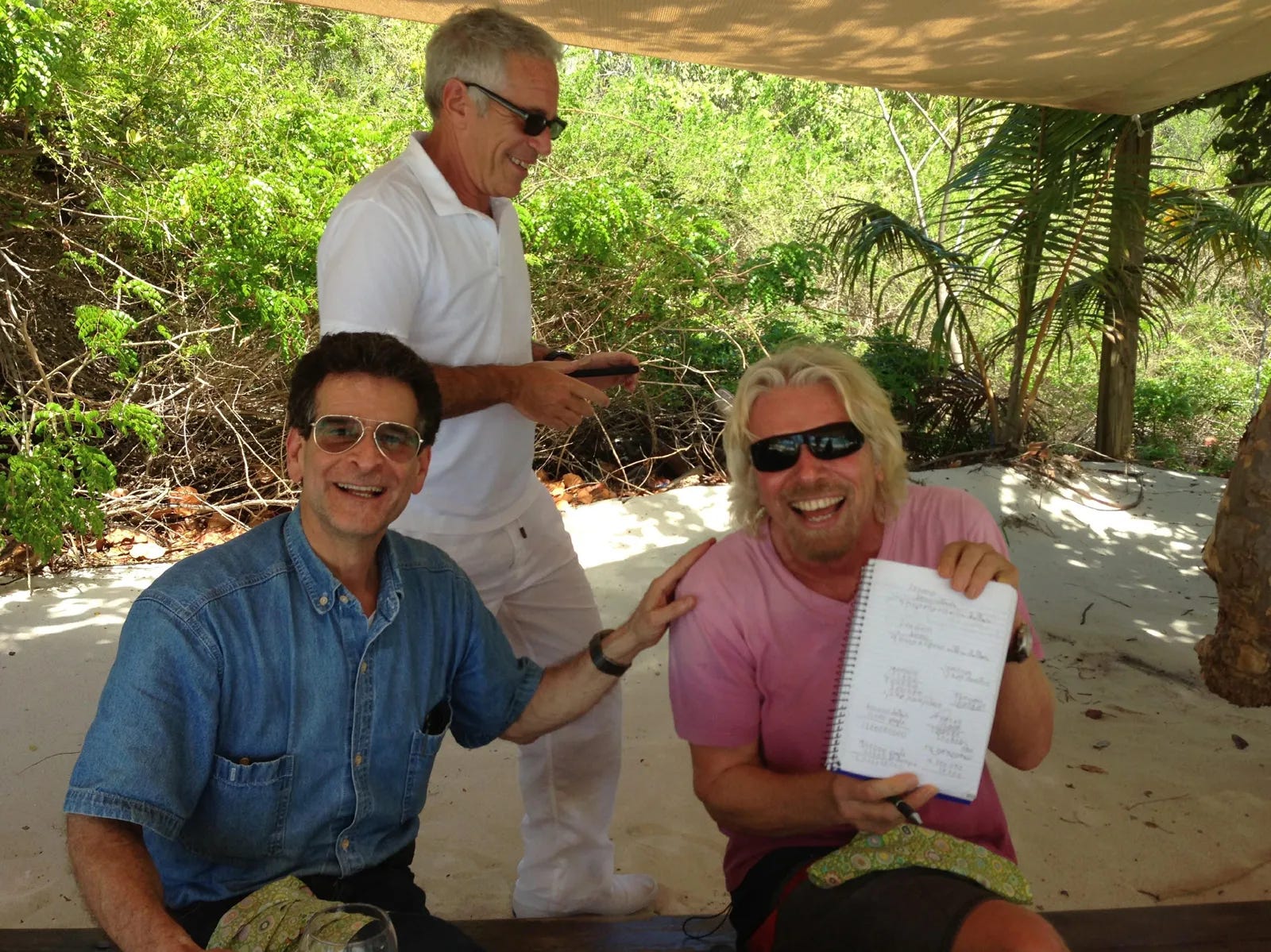
Take a look: Among those named are MAGA guru Steve Bannon and leftist academic icon Noam Chomsky; Bill Clinton and Donald Trump; Bill Gates and Trump’s Secretary of Commerce Howard Lutnick; oh, and the magician David Copperfield, the rock star Mick Jagger, the inventor Dean Kamen, the business-tycoon Richard Branson, Woody Allen, Prince Andrew, the YouTube health guru Peter Attia, and so on. (Necessary note to prevent a lawsuit: Being named here or in the Epstein Files does not mean one directly participated in illegal activity or noxious behavior, it simply puts them in Epstein’s circle.)
So, while I want to credit you and your fellow populists for smelling out the moral decrepitude and vacuity of the hyper-elites well before I did, I want to urge you to take seriously the ideological spectrum here: it’s all over the place. The conspiracy is not ideological.
I know, in our hyper-partisan mediascape, as in many academic circles, the weakness or irrelevance of ideology in organizing power can be confusing. We are all taught to think power is all about ideology. But Epstein proved us wrong.
I also want you to note that your Great Man, Donald J. Trump, even with DOJ’s presumably protective redactions, is all over the Epstein Files.
But most importantly, I want you to notice who is not appearing in them—elected representatives, particularly in the U.S. Senate or House. (A U.S. President is technically not a representative.) To be sure, it is possible that the absence of what we might call the “representative political class” in the Epstein Files is because representatives are being protected via redactions or unreleased documents. You might by thinking this right now. But I am skeptical that this is the case. I think it is already pretty apparent that ordinary senators and representatives were just not generally part of Epstein’s circles. They are not who he played with.
Not that you necessarily want to know, but I have two thoughts about the non-participation of the representative political class in Epstein’s circle, and the two thoughts I have are related to each other.
First, the absence of the representative political class is further testament to just how weak our democratic representative system is before the hyper-elites. You and I might agree on this. Epstein moved through power like hot air, ascending up as high as he could go. That he rose right past the representative political class is an indication of where the real power was (and still is): with the tech bros, with the billionaires, with influencers and entertainment headliners, with academic stars, and with captains of finance. Epstein moved in such heights, and they moved with him.
Second, and related, none of the men (or the enabling adult women) involved in Epstein’s circles seem to be people that ever spent much time talking to or relating with ordinary people. Have you ever thought about this?
What binds the hyper-elites together is not ideology. It’s being out of touch.
Yes, it is true, Q, some of the men who appear in the Epstein Files have spent time, even careers, talking to ordinary people—Copperfield on stage, Attia on YouTube, Trump and Clinton on the stump, or Chomsky in one of his countless interviews—but they did not, as a matter of practice or habit, talk with ordinary people. As an academic, I am struck by the way in which the academics who appear in the files are all the types that rarely actually teach. Out of touch.
By contrast, the U.S. Constitution—I don’t know how you feel about the Constitution—centers political power in the people even as it places “elite” power in Congress, a representative body (see Article 1). There’s a good reason for this structure. Making elite power “representative” forces elites to engage with ordinary people. For if they don’t, they won’t last long.
Q, you think the country is in dire straits. You and I agree here. But, unlike you, my reasons for alarm are not because “my side” is losing.
Rather, my concern with American democracy has to do with where real power is currently located. It is in super-representative “cliques” (super = “above” or “beyond” representation). Concretely, it is located in a morally decrepit and overly rich hyper-elite who can fly to remote islands and rape and pillage young women and girls. Real power today is centered in men and women for whom the concept of neighbor is as foreign as the idea of taking a commercial flight.
I believe that democracy provides surer and better means of security for people than other forms of government. I also believe that representative democracy, if it can be made to function well again, is the surest way of fighting the corrosive corruption of the ruling class.
So, Q, let’s learn to be democrats.
Yours in disgust and democratic determination,
Ned